The First Flowering of ‘Tsubaki Yama: Camellia Mountain’
Winter 2026 marks the first flowering of ‘Tsubaki Yama: Camellia Mountain’, the newest garden in Blue Mountains Botanic Gardens Mount Tomah, and there's so much to enjoy.
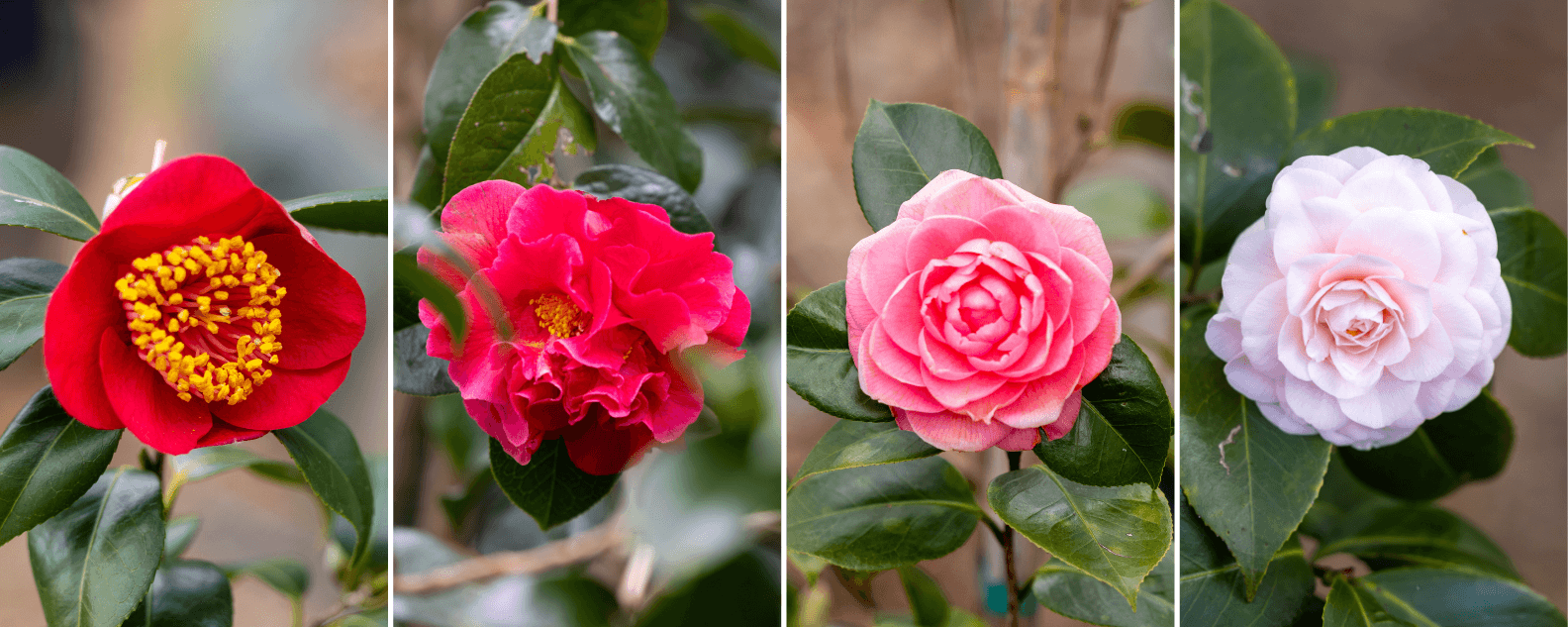
The winter of 2026 has ushered in a quiet transformation at Blue Mountains Botanic Garden Mount Tomah. Tsubaki Yama, officially opened late last year, is beginning to reveal its character as the young camellias unfurl their first flowers. Though the plants are still establishing themselves, the garden already offers a rich tapestry of history, horticulture and cultural storytelling.
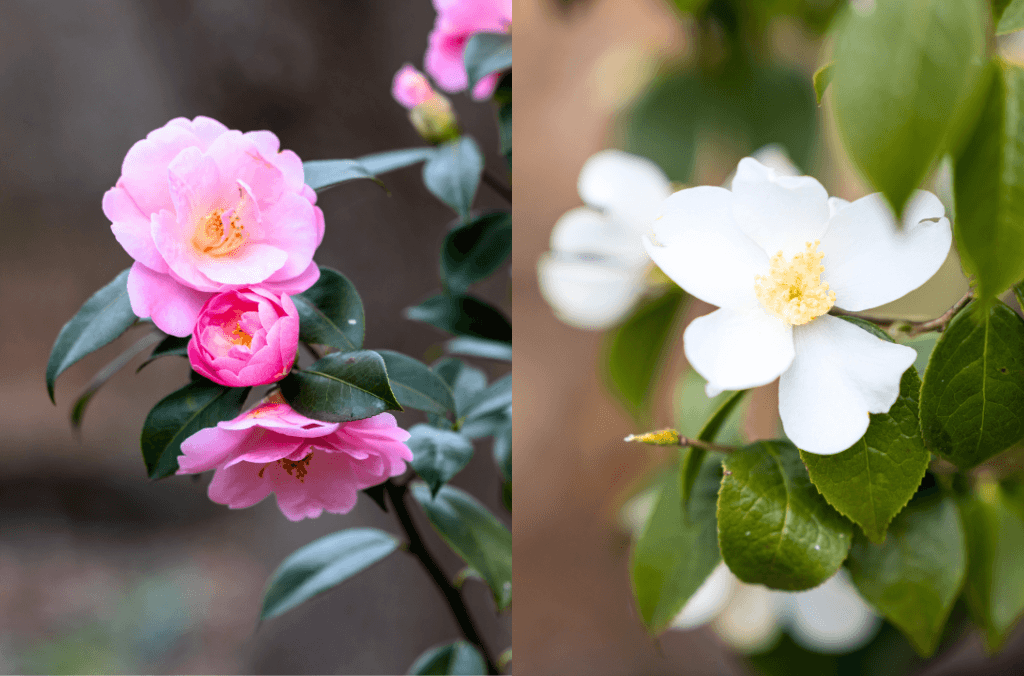
A wide variety of camellia cultivars are on show at Tsubaki Yama: Camellia Mountain at Blue Mountains Botanic Garden Mount Tomah.
A huge diversity
There are over 300 species of camellias worldwide, though the two most commonly grown in gardens would be Camellia japonica and Camellia sasanqua. There are over 20,000 camellia cultivars!
A cultivar means a specifically cultivated variety of the plant bred by people for unique traits like flower colour, petal shape, size or cold tolerance. They do not naturally occur in the wild.
Did you know?
Camellias are often grown from a cutting rather than seed. Camellia japonica has unstable genetics, and so a plant will occasionally grow a flower that looks nothing like the rest of its blooms. This is called a ‘sport’ – and it can be cut off its parent plant and grown on from cutting to create a whole new cultivar of camellia. This can be done with any Camellia japonica or Camellia sasanqua, however if it is a Camellia reticulata, originally from the south-western provinces of China, it will need to be grafted on to a root stock typically of Camellia sasanqua, as they tolerate a wider range of soil types and moist conditions better than Camellia japonica.
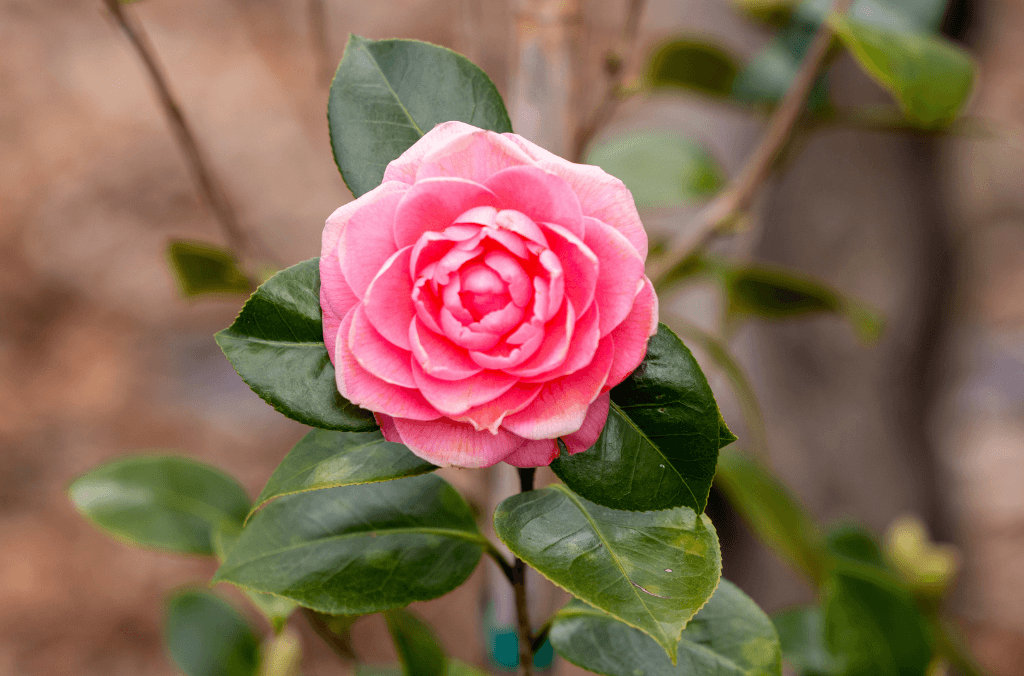
Camellia cultivars with formal double flowers: Camellia japonica 'Prince Frederick William' 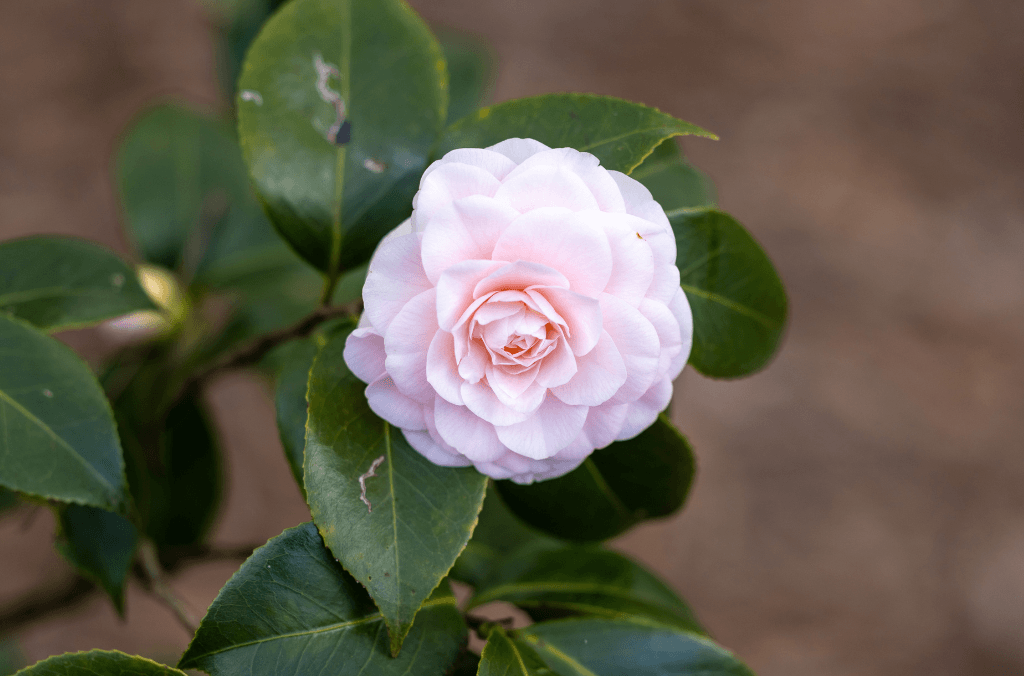
Camellia cultivars with formal double flowers: Camellia japonica 'Fen Chang'e Cai' aka Pink Goddess of the Moon
See the history of Camellias in Australia with your own eyes
As you enter Tsubaki Yama, look to your left. What is on display is a representation of the history of camellias in Australia over time.
One of the first plants you can see is Camellia japonica ‘Incarnata’, also known as ‘Lady Hume’s Blush’, which is thought to be the very first camellia species ever brought to Australia. It reached our shores in 1826, in a shipment for Alexander Macleay of Sydney. At this time, a single camellia plant cost about as much as it cost to employ a maid for an entire year. Talk about fancy plants!
Nearby you can find Camellia japonica, ‘Aspasia Macarthur’ which is the first ever camellia cultivar bred in Australia. It came about as other camellia species reached Australia in 1831 in a shipment for William Macarthur, a botanist and horticulturist amongst other things. William lived at Camden Park, south-west of Sydney, and it was there that the ‘Aspasia Macarthur’ was bred.
As you slowly move across this area, note the differences in the flowers of the different types of camellia. It’s not just the colours that are different. Just as fashions change with each generation, so too were there trends in the most popular styles of camellia flower over time.
The flowers of Australia’s earliest camellia imports were singles and formal doubles, one such example is the Camellia japonica ‘Prince Frederick William’ from 1872, the flower of which has more than one row of petals and appears symmetrical, almost mathematical, with an overlapping spiral of petals without any visible stamens. These flowers look almost like roses. The heavily tiered, uniformed rows of these formal doubles mirrored structurally engineered Victorian-era ballgowns echoing an industrialising society’s desire to conquer natural disorder in favour of mechanical perfection. In the mid-century (1940s-1960s), Camellia flowers evolved into peony and anemone shapes with hybridizers like Professor EG Waterhouse breeding cultivars such as 'Lillian Pitts' and 'Andromeda', which mirrored the sharply tailored stripes and complex ruffled textures of garments in a post-war society that rejected wartime rationing in lieu of hyper-feminine luxury.
Camellia sasanqua was popular in the post-War period, and they’ve been widely used in formal privacy hedges.
Look out also for the largest camellia flowers of the Camellia reticulata.
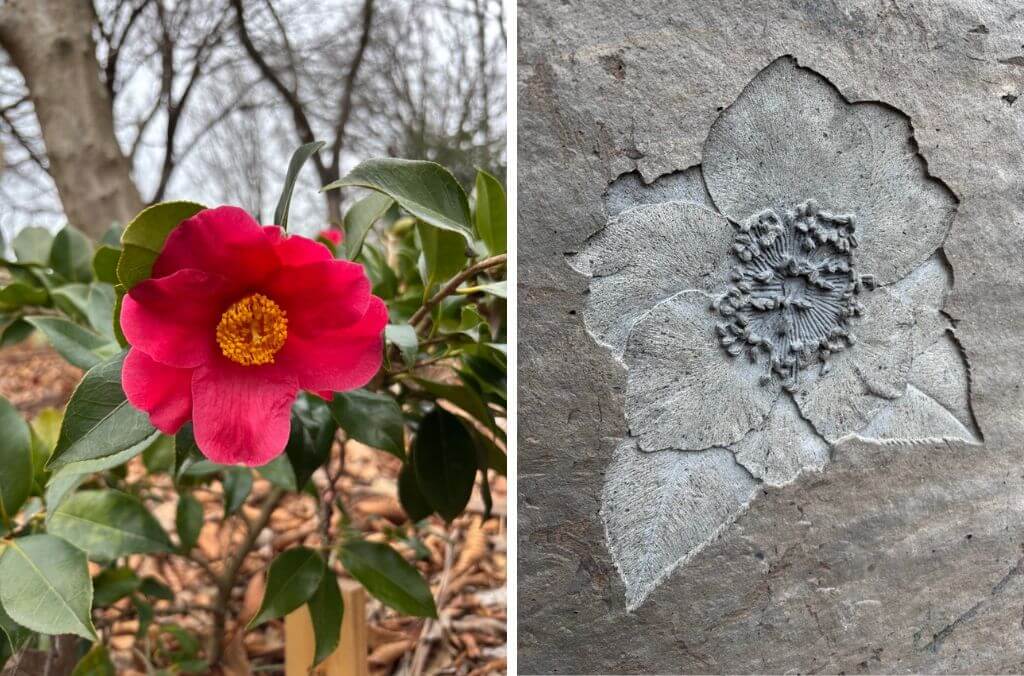
The flowers engraved on the basalt pillars in the middle of Tsubaki Yama are Higo camellias.
Celebrating Japan's rich camellia heritage
Higo camellias, cultivated by Japanese samurai, didn’t arrive in Australia until the 1970s and 80s. These highly specialised Camellia japonicas are renowned for their striking, single-form blossoms and massive, sunburst-like cluster of golden stamens.
Higo camellias must have less than 250 stamens, and no more than nine petals, in a single row. Did you know – the flowers engraved on the basalt pillars in the middle of Tsubaki Yama are Higo camellias.
Higo camellias were prized by samurai, as their flowers fell ‘honourably’ – the entire flowerhead falling from the plant at once, rather than withering on the plant or losing petals gradually.
Higo camellias often have one stripe of colour amongst their petals. This was reflected in the fairy ring at the centre of Tsubaki Yama. In winter you can see a ring of red Acer palmatum ‘Sango Kaku’ - Coral-barked Maple, and yet you might notice that one amongst their number has brown bark, this cultivar is a lone Acer palmatum ‘Emperor One’. This was done deliberately to call back to the distinctive stripe of colour on the Higo camellia flower.
This fairy ring contains around 15,000 miniature Mondo Grasses densely mass planted, which gives the effect of soft green cushions all around.
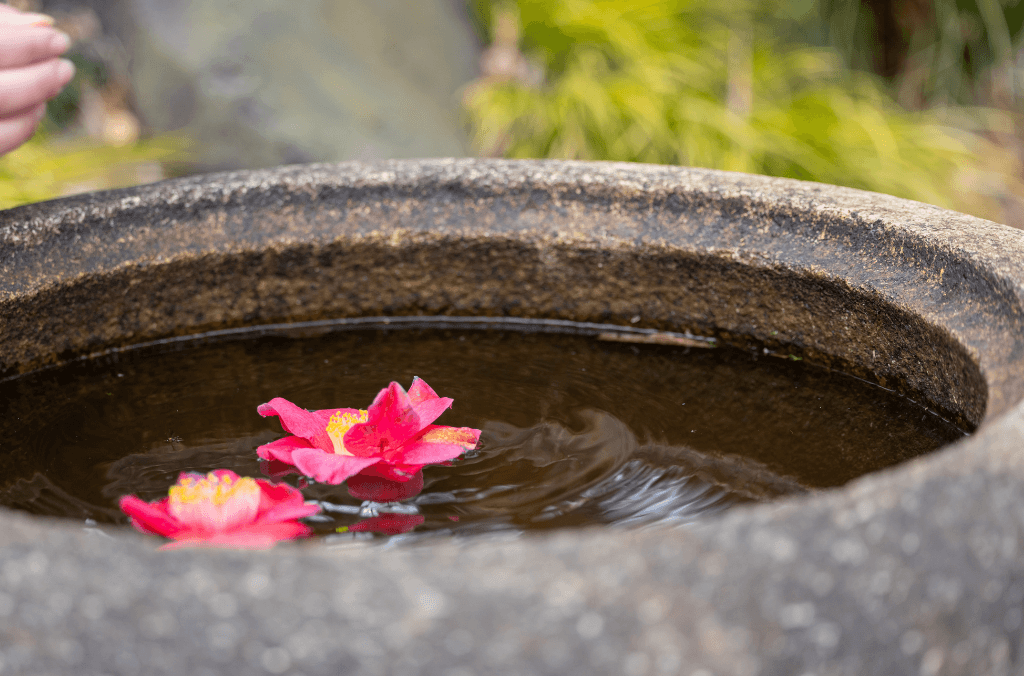
The large granite water basins are shaped as natsume - rounded lacquered wooden containers used in Japanese tea ceremony to hold powdered matcha. 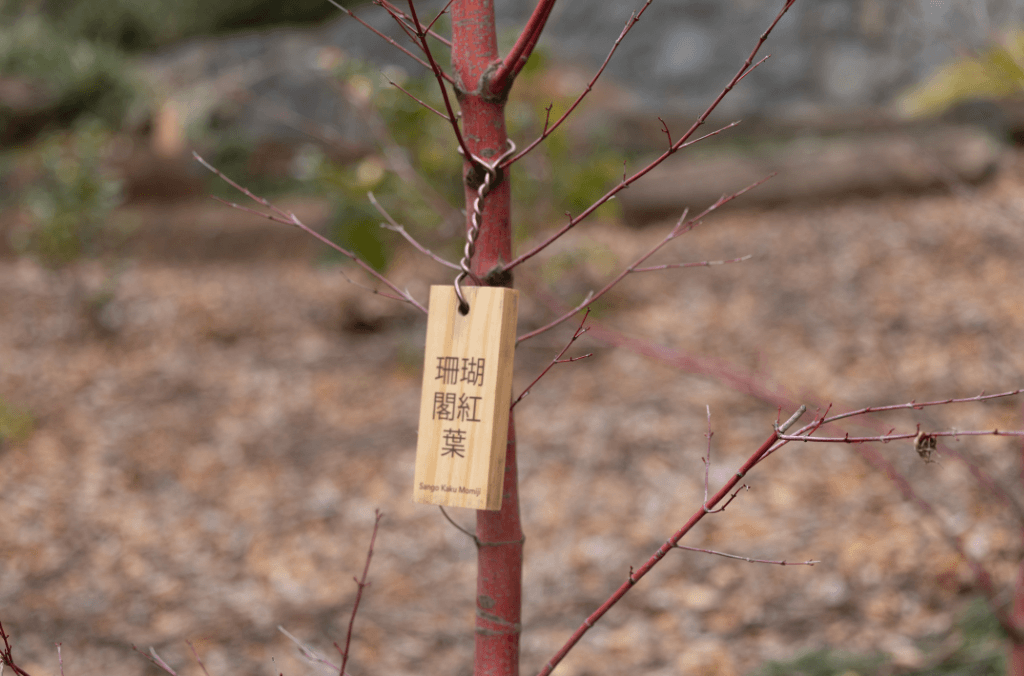
The red bark of the Coral-bark Maple is on show in the cooler months when the plant is bare of leaves.
Did you know?
‘ensis’ in a plant name denotes in botanical Latin that a plant comes from that place so sinensis (as in Camellia sinensis – the plant from which we get tea) means ‘Chinese’ and Camellia yunnanensis means ‘of Yunnan,’ which is a province of China.
Spilling the Tea
In Tsubaki Yama, you can see Camellia sinensis var. sinensis, which comes from China. The new leaves of this plant are used to make matcha, green, white and oolong teas. You can also see Camellia sinensis var. assamica, which was named after the Assam region of northeastern India where it is a native variety – a cousin of Camellia sinensis var. sinensis. Assamica is a larger leaved variety that is most commonly used for black teas like English Breakfast, Irish Breakfast, Darjeeling and, you guessed it, Assam.
Note that these tea varieties of camellia also have flowers, but tiny ones compared to Camellia japonicas and others. The large water features in Tsubaki Yama are based on traditional natsume: containers used in Japanese tea ceremonies to hold powdered matcha, a finely powdered bright green tea processed from leaves of Camellia sinensis var. sinensis grown in the shade to increase chlorophyll content.
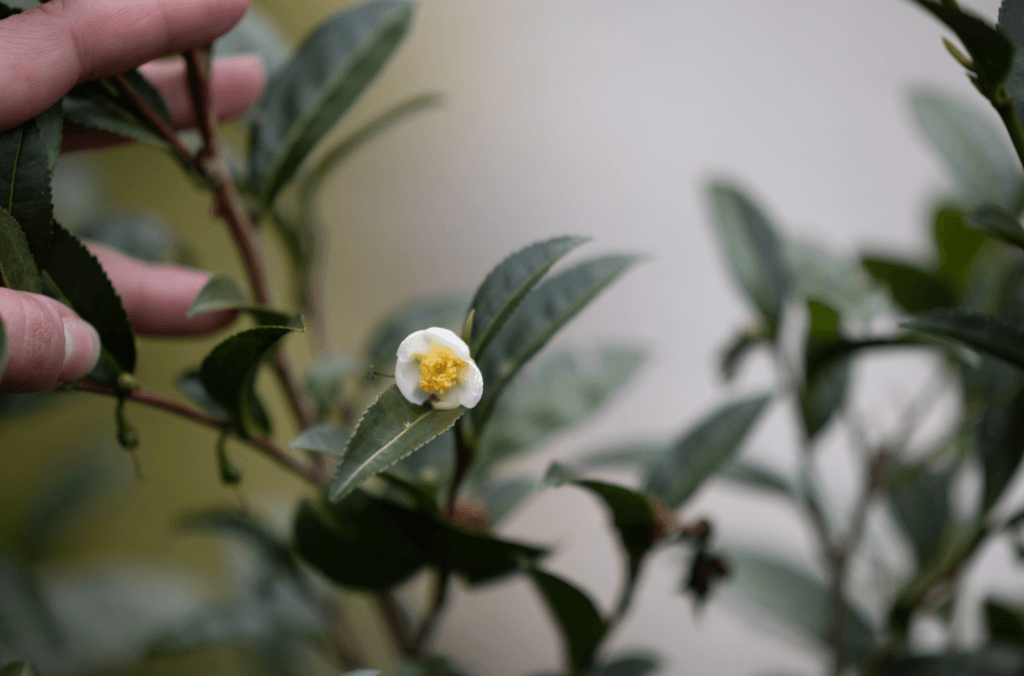
Camellia sinensis has tiny flowers but is grown for its new leaves, from which tea is made.
Coming Soon to Tsubaki Yama
Phase two of Tsubaki Yama is in development, and will feature culturally significant Chinese camellias.
At Tsubaki Yama you can see a rare beauty - the Pink Goddess of the Moon, Camellia japonica ‘Fen Chang’e Cai’. This is one of the most revered, rare and historically significant camellia cultivars from China. This ancient variety has been cultivated in the historic camellia-growing city of Jinhua in Zhejiang Province for over 500 years. Back in 2003 at the first International Camellia Society Congress in China, the mayor of Jinhua presented Bob Cherry with this plant as a gift to Australia.
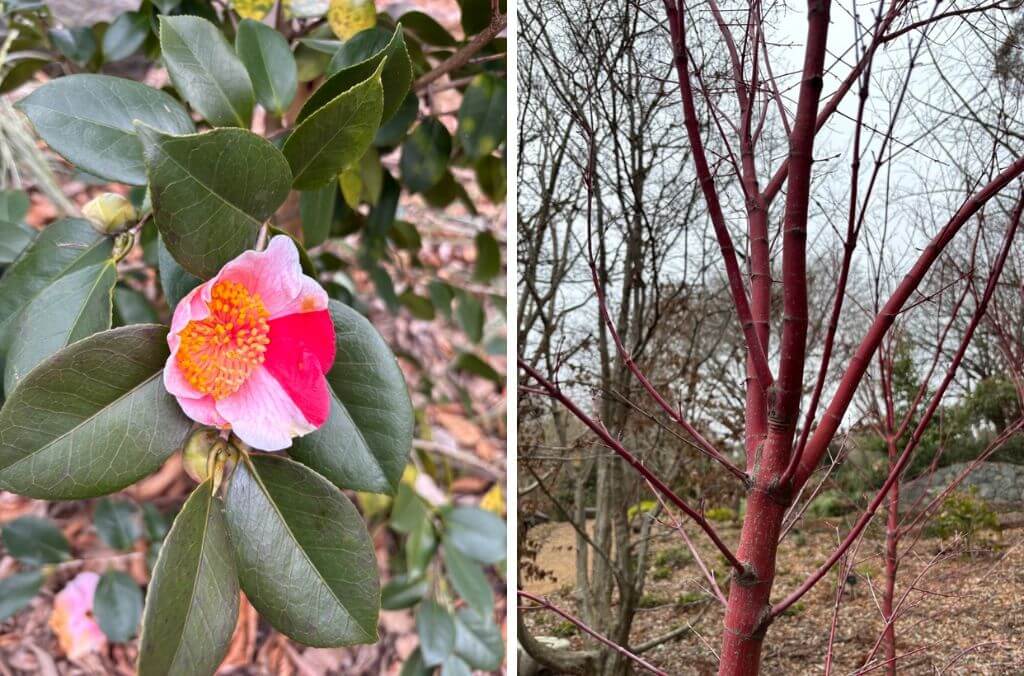
Left: a Higo camellia with a distinctive stripe or differently coloured petal. Right: The Coral-bark Maple (Acer palmatum Sango Kaku Momji)
A nearby neighbour
And before you go, don’t miss the de Ferranti Pavillion, which is accessible via Tsubaki Yama. Inside, if you look up, you may just spot a Brush-tailed Possum or two who like to snooze up in the rafters.
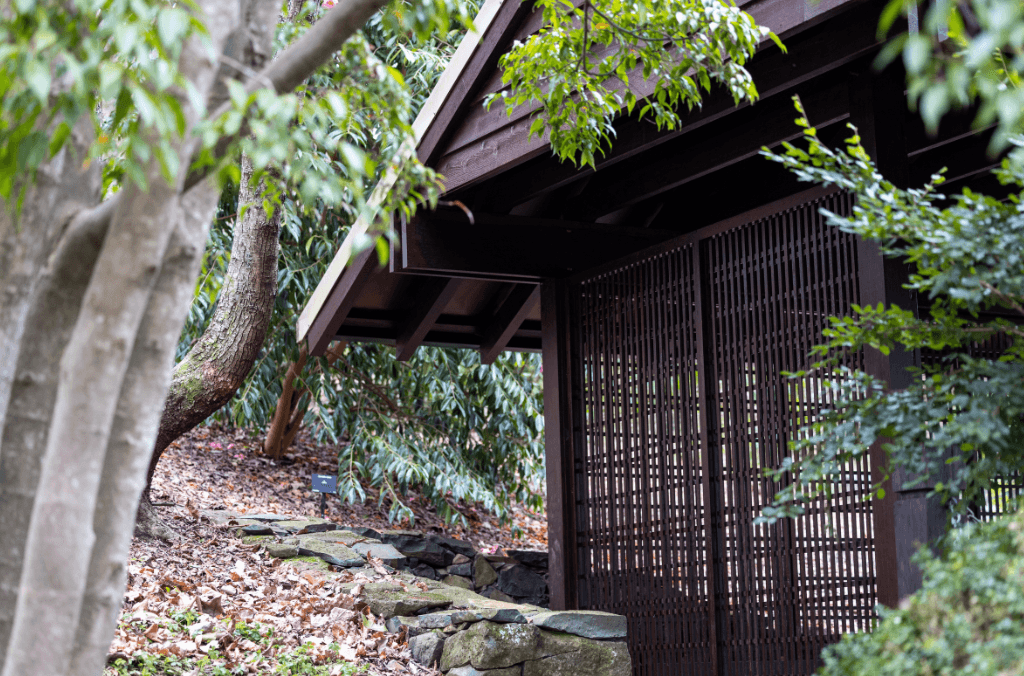
This pavilion was made possible through a generous donation from Raoul de Ferranti and his sister Susanne de Ferranti in memory of his parents, Maurice and Joyce de Ferranti.
Related stories
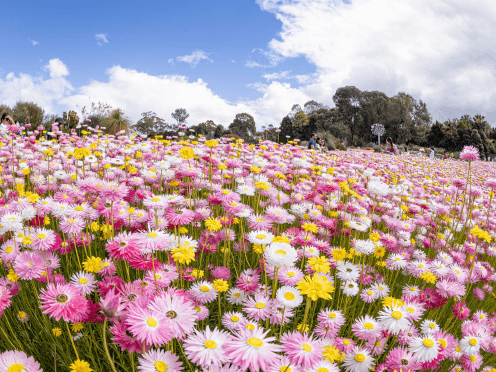
Discover the fascinating story behind Sydney's biggest paper daisy display and why these remarkable native flowers captivate visitors every year at Australian Botanic Garden Mount Annan.
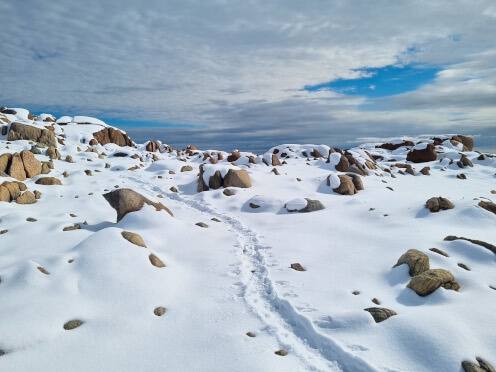
In Antarctica’s frozen deserts, scientists are uncovering extraordinary fungi that survive where almost nothing else can, writes Professor Brett Summerell AM, Chief Scientist and Director Science, Education and Conservation.
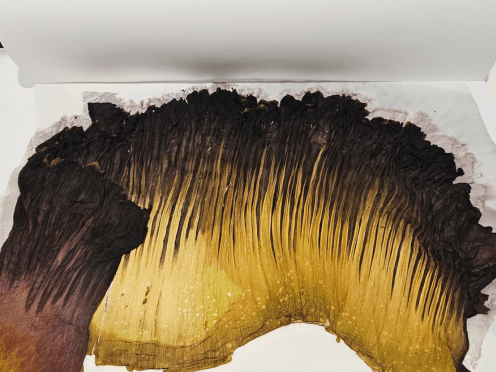
Come behind the scenes on a botanical journey to preserve the first ever corpse flower in the National Herbarium of New South Wales.