Forest bathing
Shinrin-yoku or “forest bathing”, the Japanese practice of immersing oneself in the atmosphere of the forest, is a balm for the body and soul, writes Marion Whitehead, Supervisor Ornamental Gardens and Nursery Mount Tomah.
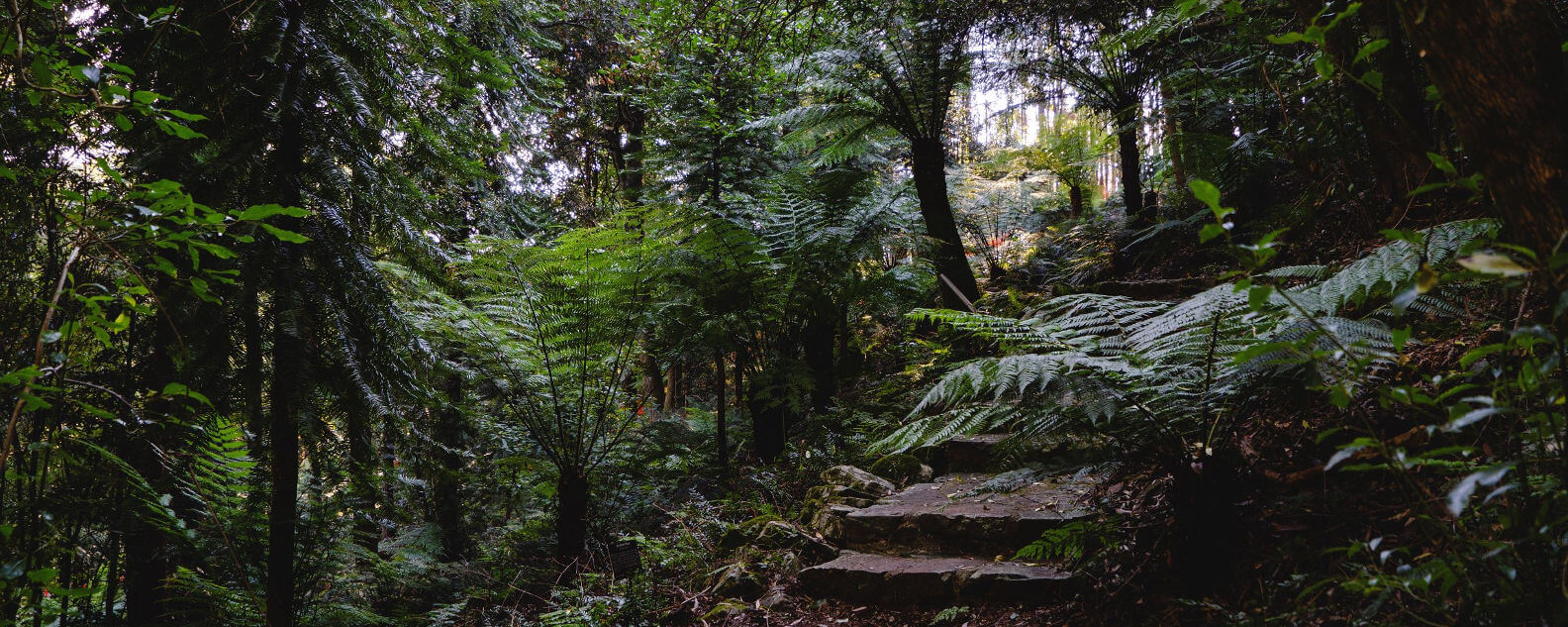
Shinrin-yoku or “forest bathing”, the Japanese practice of immersing oneself in the atmosphere of the forest, is a balm for the body and soul, writes Marion Whitehead, Supervisor Ornamental Gardens and Nursery Mount Tomah.
I haven’t missed a day of running in three years. It started out as a New Year’s resolution, but that quickly felt trivial as my daily incursions into the heathlands and forests of the Blue Mountains National Park became indispensable to my wellbeing and happiness.
Every morning, I woke knowing that I would run somewhere, at some point, and that immersion in nature was a foregone conclusion. The run and the forest became inseparable. And it was no different when I found myself in the town of Nikkō, north of Tokyo, on my birthday last year. I knew there would be running, and I knew I would be among trees where I am always happiest.
It was on a Japanese hillside, ablaze with the last of the autumn colour, that I realised what I had been doing for the previous 1,040 days had a name. Shinrin-yoku or “forest bathing” the Japanese practice of immersing oneself in the atmosphere of the forest.
We had travelled to Japan as a family after I was lucky enough to attend the International Camellia Congress in Tokyo earlier that year. From March onwards, I endured months of plaintive cries of “Can we go to Japan too?!” from my two boys, until we finally returned together in November.
On my birthday, my partner organised a walk through Ryuokyo Gorge, a deep, river-carved canyon outside Nikkō, where we crossed bridges and wandered slowly through the tail end of the season. Like my run streak, shinrin-yoku is not about exercise, fitness, or achievement. Nor is it about belief, ritual, or instruction. It is simply about attentiveness. When we forest bathe, we aren’t trying to conquer nature or consume it, we are allowing ourselves to be absorbed into it.
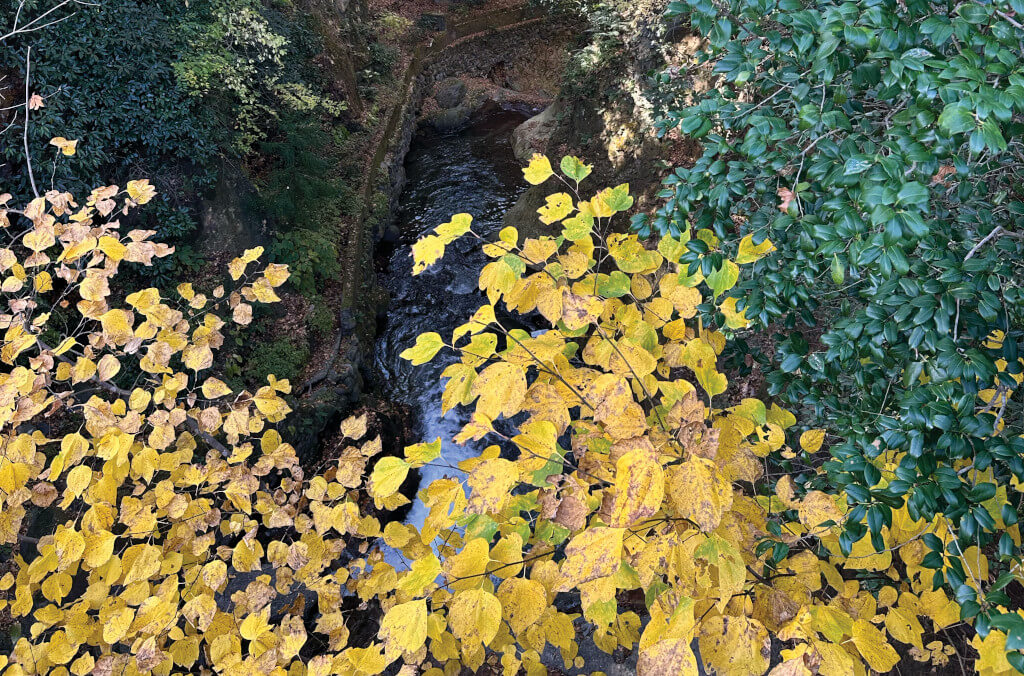
Lindera obtusiloba in full autumn colour.
Absorbing nature
Plants are already deeply woven into our lives. My children have grown up watching Studio Ghibli films where forests are sentient, protective, sometimes dangerous, but always deserving of respect. At home, they learn plants not from labels but from proximity, from being in the bush constantly, and stopping mid-walk to learn about the plant adaptations of a Stylidium (trigger plants) or to marvel at a carnivorous Drosera (sundew). Japan felt like an extension of that education, not a departure from it.
At Ryuokyo Gorge, the boys were captivated. The Arisaema (Jack-in-the-pulpits) were impossible to miss, their brilliant red seed heads poking jauntily from the forest floor. The river itself was a shock of colour, a vivid, electric blue water coursing over pale stone throwing into relief the blood-red leaves of Acer palmatum (Japanese maple) and the golden light filtering through the last of the Carpinus leaves above us. Even the familiar was comforting: the azaleas (Rhododendron species), no longer in flower, carpeted the forest floor with foliage I recognised instantly. Being so far from home, yet surrounded by plants I have revered forever, was deeply grounding.
Before I heard about the term shinrin-yoku, I had been practicing it instinctively. I have always gone into the bush when I feel overwhelmed, stressed, sad, or joyful. It is where I celebrate and where I retreat. Learning that this way of being had been named, studied, and culturally embedded elsewhere felt less like discovery and more like recognition.
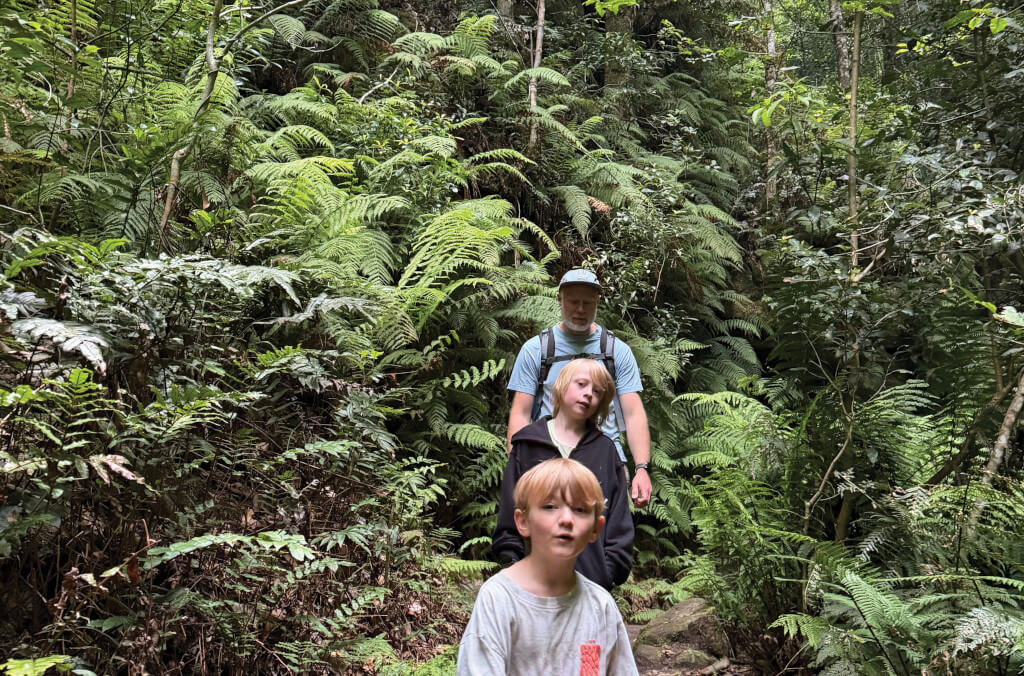
George, Max and Nick Whitehead in the Grand Canyon, Blackheath.
Taking lessons home
Returning home after Japan, I began to see the coachwood and sassafras forests differently. I am well known for immediately diverting off paths on runs or walks, cutting away at forty-five-degree angles to follow a botanical curiosity rather than trail markers. Now, layered over the desire to observe and understand every part of the natural world around me, I began to notice Japanese philosophical ideas reflected everywhere.
I see kami, the Shinto belief that spirits inhabit elements of the natural world, in the immense trunks of Angophora costata (Sydney red gum), their smooth bark peeling and oozing over sandstone boulders as if the trees themselves are in motion. I see it in the stately fronds of Dicksonia antarctica, tree ferns that trace their lineage back to a time before dinosaurs, standing watch over valleys like ancient sentinels.
I see yūgen – a Japanese aesthetic meaning the profound, partially hidden depth of things – in the ancient fragments of escarpment that have broken away over millennia and now lie scattered across the forest floor, softened and obscured by moss. These stones do not announce their age or their origin. Their beauty lies in what they withhold. And I see wabi-sabi in the quiet acceptance of decay, impermanence, and return, in fallen branches, decomposing logs, and the slow reclamation of human paths by plant life.
"Now, layered over the desire to observe and understand every part of the natural world around me, I began to notice Japanese philosophical ideas reflected everywhere." - Marion Whitehead
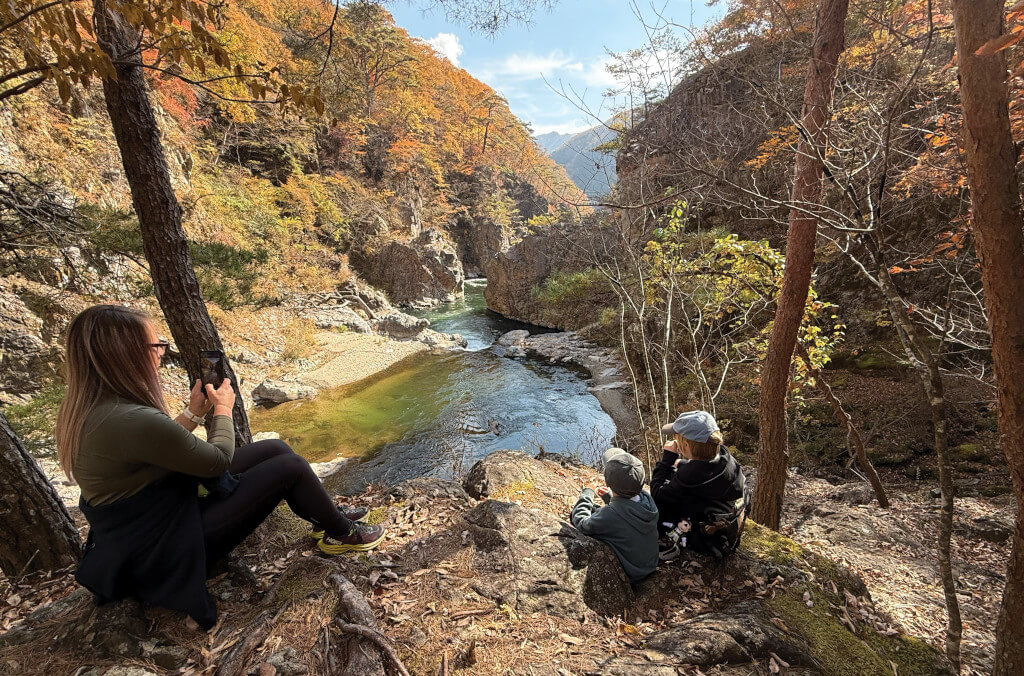
Marion, George and Max taking in the last of the autumn sun in Nikko.
Respecting the landscape
There is something about how long these rainforests and clifftop ecosystems have been cherished and cared for. With the Darug and Gundungurra peoples living with, moving through, and cherishing these places for thousands of years, passing through these spaces myself makes me feel connected to other people and other times through plants, even when I am alone. The traditional owners of this land know better than anyone how to observe closely and act carefully, how to exist as custodians rather than owners.
There are plants I would never attempt to grow in my garden not because I couldn’t, but because I shouldn’t. Small Pterostylis orchids belong where they are, emerging quietly in winter, seen only by those willing to look closely. Instead of trying to possess them, I get to do something far better; I get to visit them, year after year, acknowledging that not all relationships with nature are meant to be extractive.
Shinrin-yoku may be the Japanese words that encompass this practice, but the experience itself is universal. Immersing ourselves in nature is a deeply human instinct, one that transcends language, culture, and time. It is why plants are such powerful unifiers. They remind us that whatever we are feeling has been felt before beneath different canopies, on different soils, and across vast stretches of history.
This story was originally published in The Gardens, the quarterly magazine of Botanic Gardens of Sydney.
The Gardens is the exclusive magazine for Foundation & Friends members. Join today and receive the next issue delivered direct to your door. Each edition features behind-the-scenes conservation work, cultural stories, and inspiring seasonal gardening highlights.
Enjoy discounts, exclusive events and experiences, and the knowledge that you are part of a passionate community making a difference.
Related stories
Discover the fascinating story behind Sydney's biggest paper daisy display and why these remarkable native flowers captivate visitors every year at Australian Botanic Garden Mount Annan.
In Antarctica’s frozen deserts, scientists are uncovering extraordinary fungi that survive where almost nothing else can, writes Professor Brett Summerell AM, Chief Scientist and Director Science, Education and Conservation.
Come behind the scenes on a botanical journey to preserve the first ever corpse flower in the National Herbarium of New South Wales.