Preserving Stinkerella, our first Corpse Flower specimen
Come behind the scenes on a botanical journey to preserve the first ever corpse flower in the National Herbarium of New South Wales.
On Sunday 9 November 2025 the Garden's third corpse flower (Amorphophallus titanum) for the year bloomed at the Royal Botanic Garden Sydney. It was named Stinkerella after casting a public vote for a nickname on social media.
Although Stinkerella was not on public display, important work continued behind the scenes to collect pollen needed to help strengthen genetic diversity and contribute to global efforts to protect the species in the wild.
But for Stinkerella, that was not her only contribution to science. She was also about to become the first Amorphophallus titanum specimen in the National Herbarium of New South Wales and soon available to researchers around the world.
Collections Manager, Dr Hannah McPherson taking us through the process of preserving Stinkerella
Harvesting Stinkerella for long term preservation
Daniella Pascqualini is the Supervisor of Horticultural Development and along with fellow Horticulturalist Alyse Baume, they have nurtured and studied the Garden's corpse flowers in the nursery throughout the year. On the 10 November 2025 following Stinkerella's bloom, they carefully harvested the spathe and spadix to send to the Australian Botanic Garden Mount Annan for preservation in our herbarium collection.
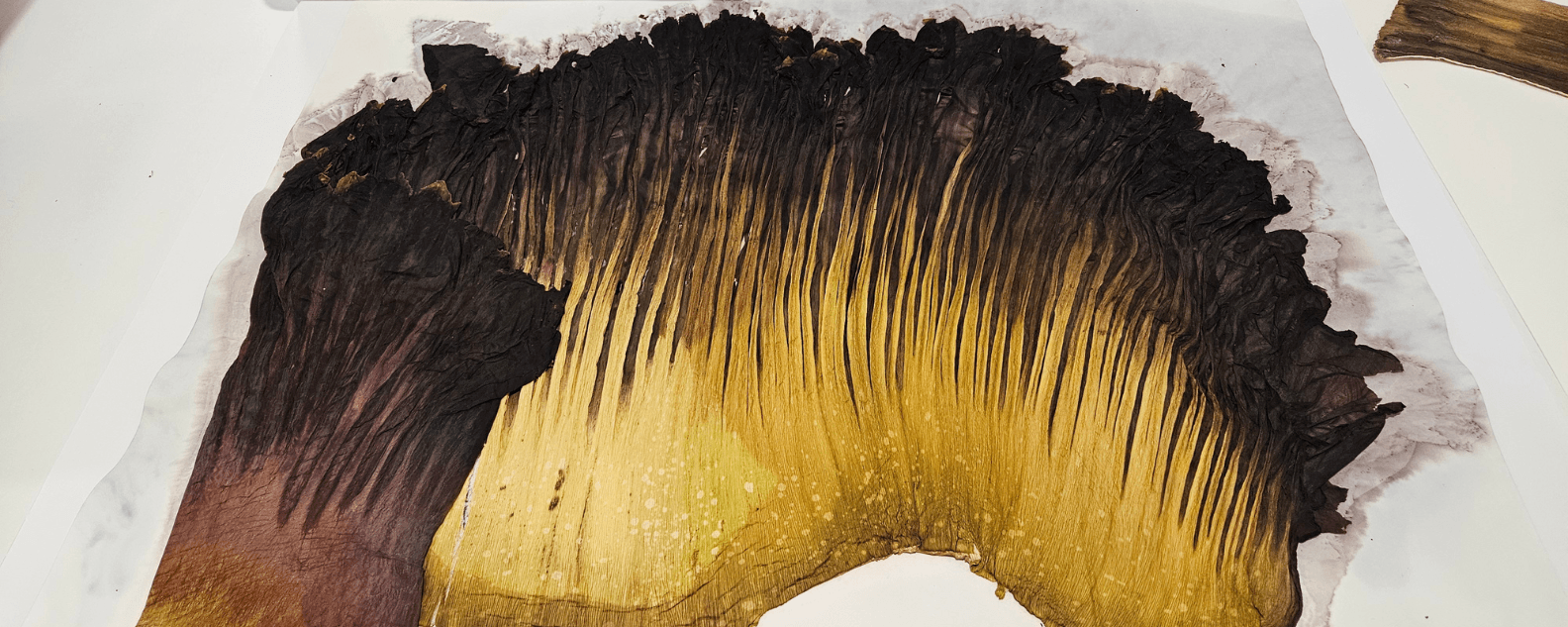
But how does one preserve such a giant and stinky specimen? When the beautiful deep red spathe arrived at the National Herbarium of New South Wales, it had the teams scratching their heads as to the best way to preserve it.
At roughly a metre long it was not an easy sample to deal with. They decided that it would be a shame to cut it into smaller, more manageable pieces - so they attempted to press and dry the whole thing.
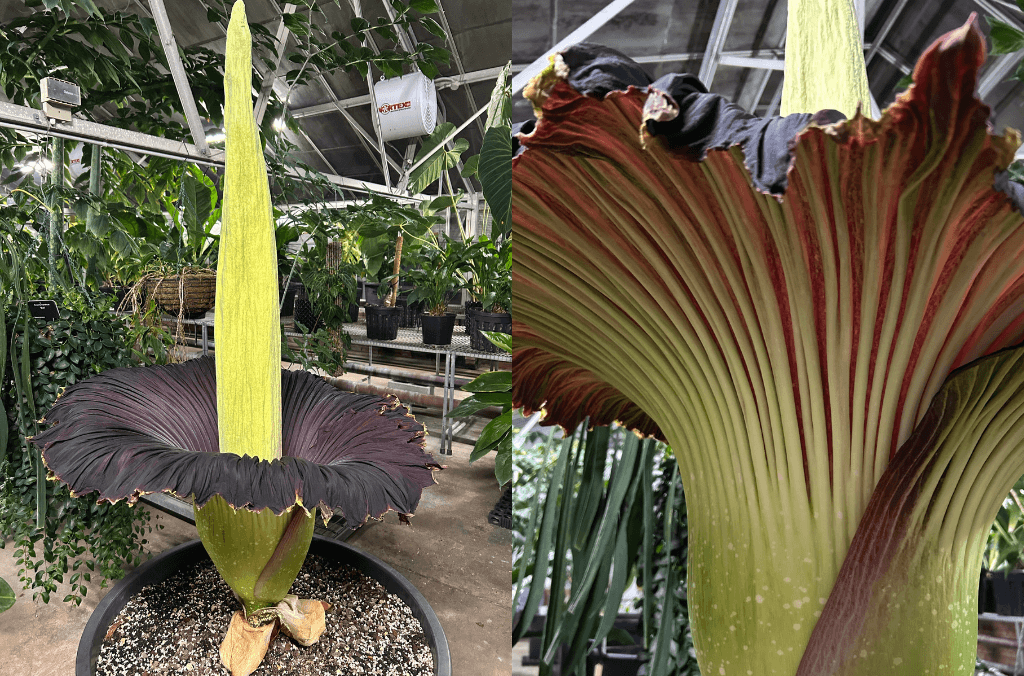
Stinkerella the Corpse Flower in the nursery at Royal Botanic Garden Sydney 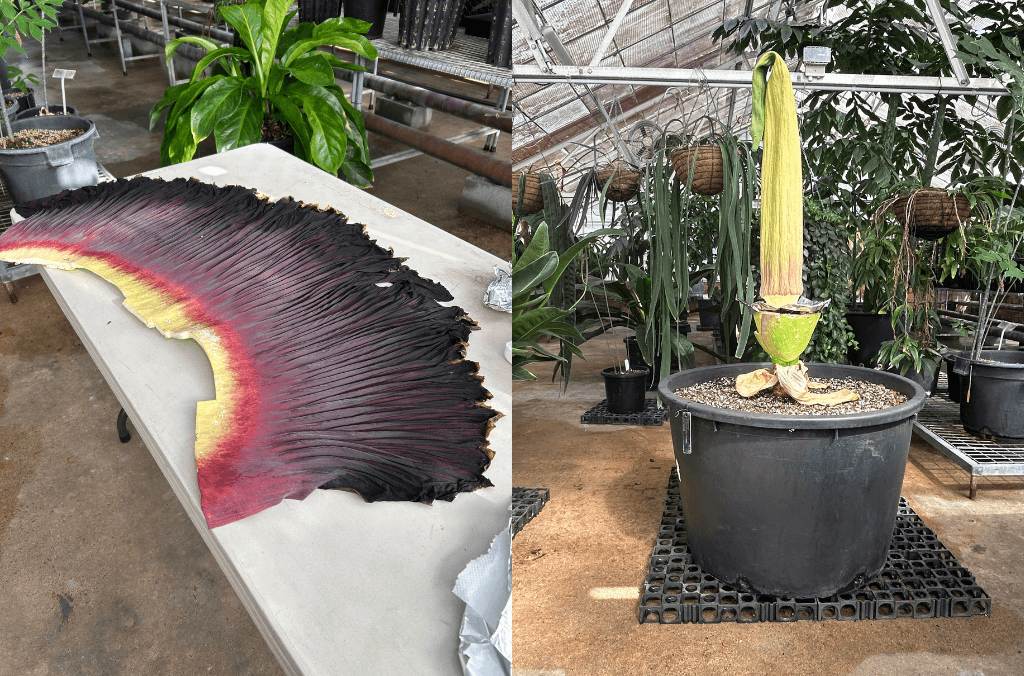
Left: Cut edge of spathe; Right: Spathe removed from corpse flower 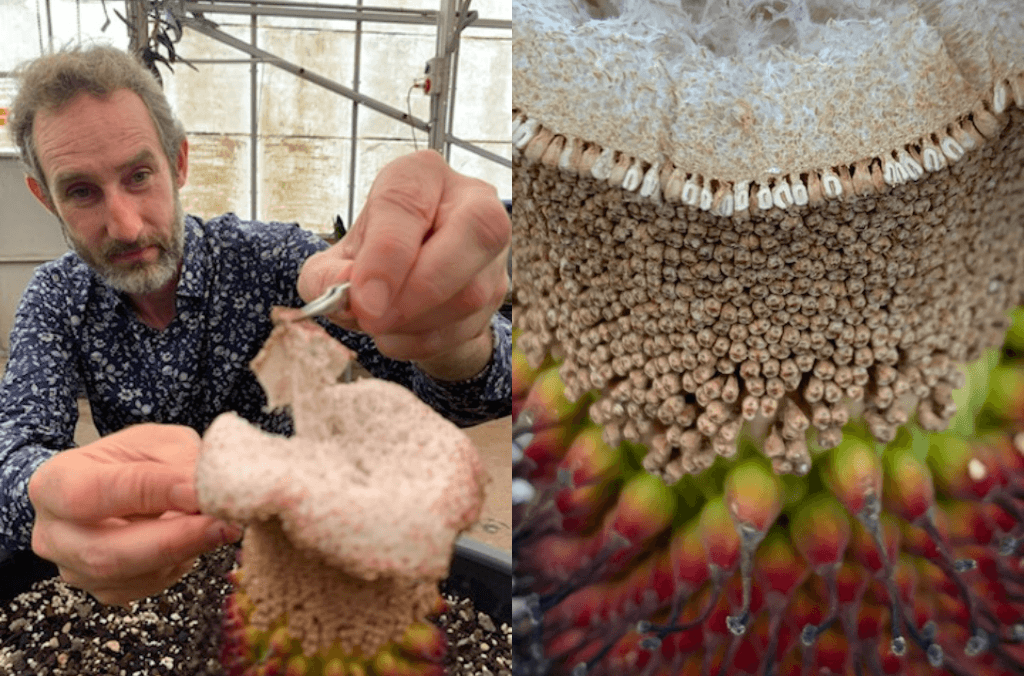
Two immature fruits and two sections of dead male flowers were collected and preserved in 70% ethanol to complete the herbarium specimen
Fashioning an oversized plant press
Using cardboard boxes, newspapers, foam and bulldog clips the team customised a plant press large enough for the spathe. They took the shelves out of a drying cabinet and the press only just made it into the space standing upright. The lower part of the spathe was very spongey and thick so they wondered how well and how quickly it would dry.
Checking on the press after 24 hours they found the edges were very dry and brittle and the base was still spongey and wet. This was not surprising, but the team were not happy to find that such a large press on it’s end with such a heavy specimen inside had bowed slightly and the specimen had not dried flat.
The whole thing had shrunk (which was expected) but the outer edges had large, deep crenelations that were extremely brittle. They knew it wouldn't be possible to safely store a specimen like this long-term.
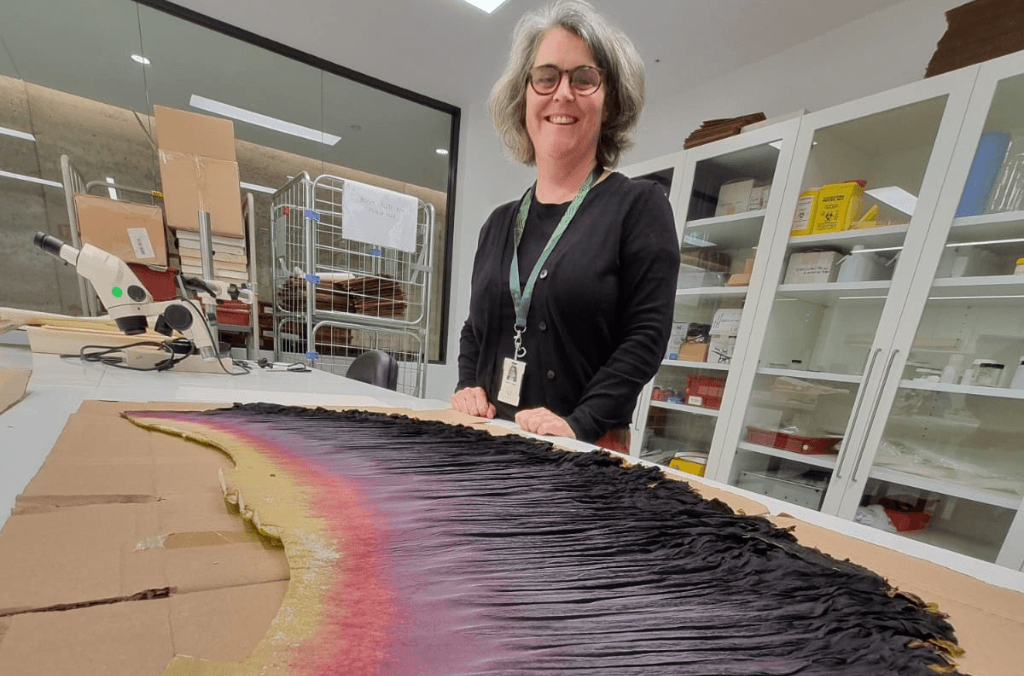
The spathe laid out in the Herbarium in front of our Volunteer Coordintor, Jude Wright for scale 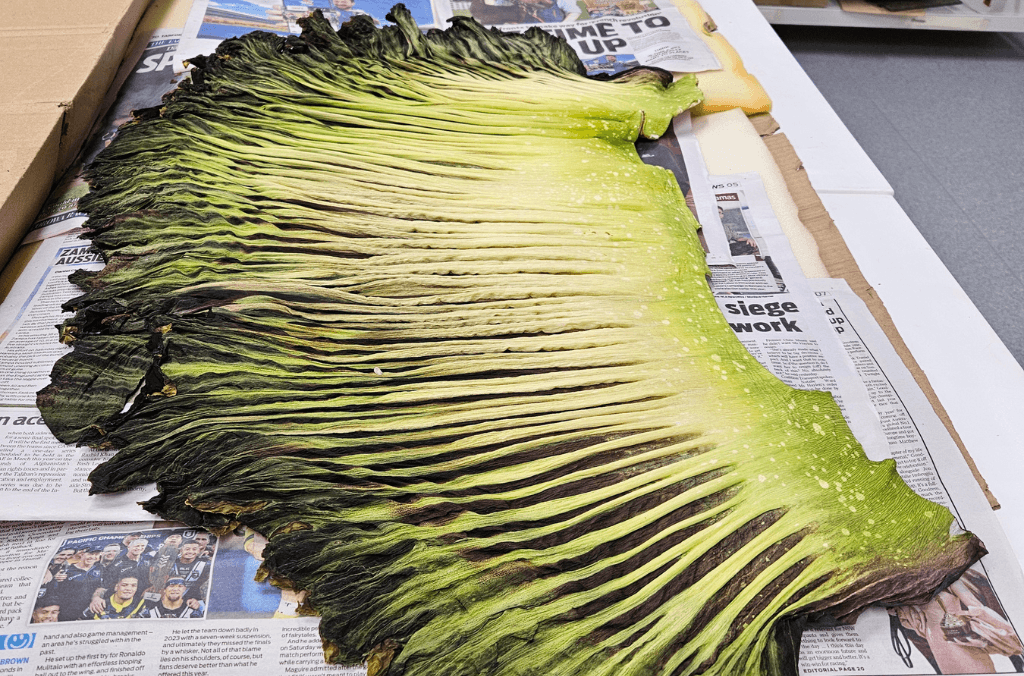
Stinkarella’s spathe after drying, showing crenelated, crispy, fragile edges
Giving Stinkerella a bath
The team decided to rehydrate the spathe and give the pressing another go. Finding a bath big enough was a challenge, but once they had commandeered a bunding trolley, they filled it with lukewarm water and a little detergent, laid a sheet of plastic to act as a lifter and some archival, cotton paper for support. Every so slowly, the team carefully submerged the spathe in the bath.
Rehydrating was a success in terms of relaxing the very brittle edges of the spathe, however, the colour started to leach out - so they needed to work quickly to get the spathe out of the water and into a new press.
They decided to display some of each side of the spathe for the specimen. This served two purposes – to allow people studying the specimen in the herbarium to see both the front and back without too much handling, and to fit the spathe on the A1 paper.
The team explained it was interesting to watch the pink dye from the bath turn blue as it hit the air. After, they placed the spathe on lint free tissue and blotted until it was free of excess water.
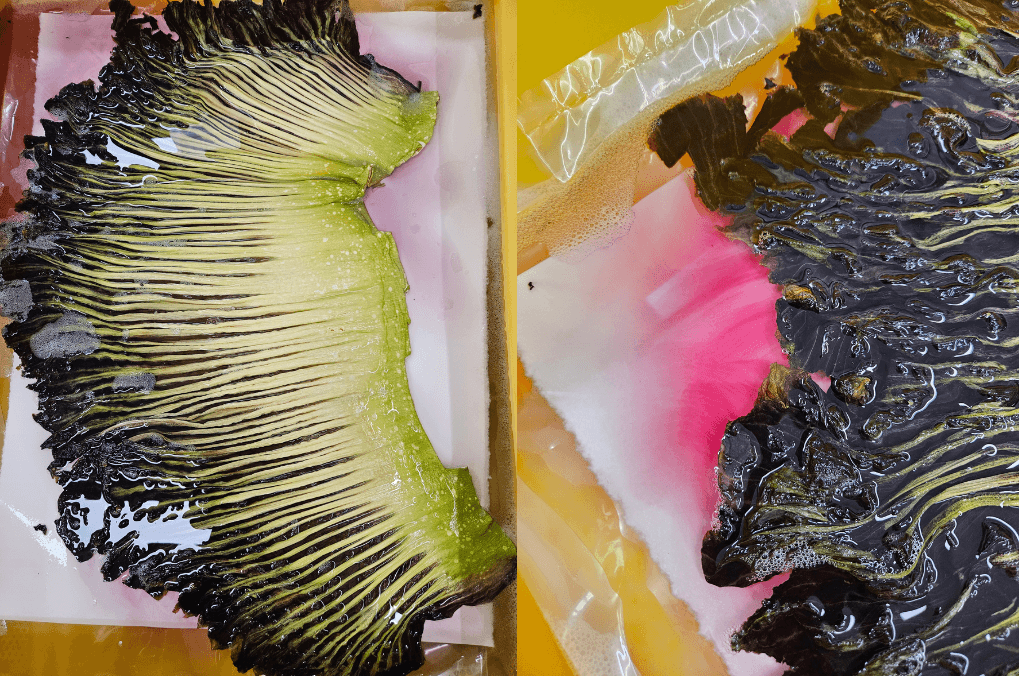
Left: Carefully rehydrating the spathe; Right: colour leaching from the spathe 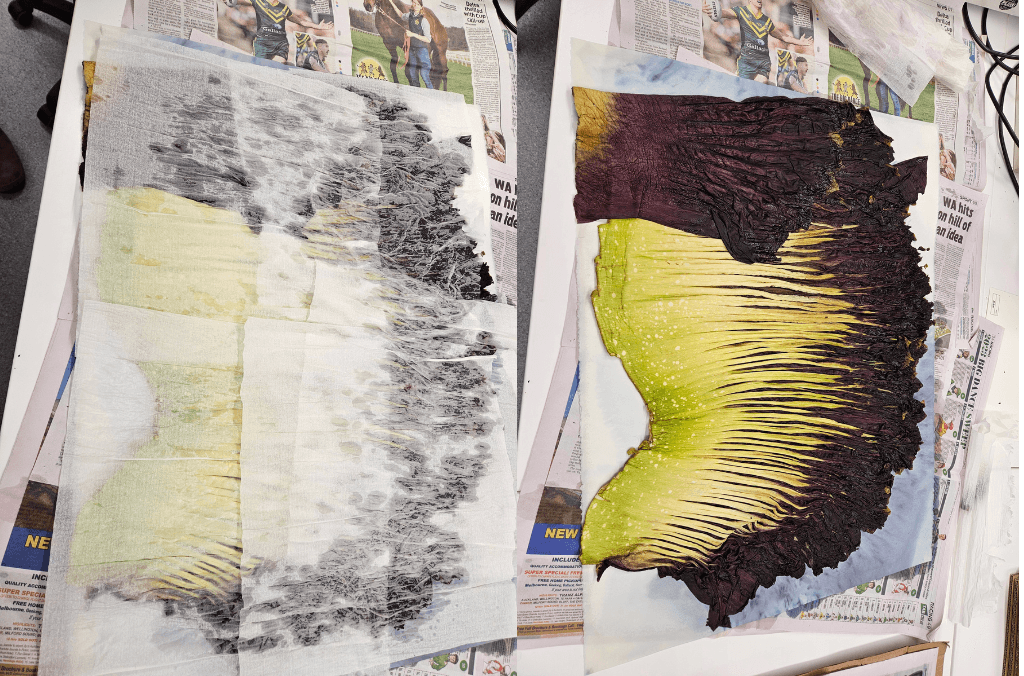
Left: blotting the spathe to remove excess water; Right: the spathe ready for the press
Pickling Stinkerella’s spadix
Next, they tackled the spadix that had been placed in the fume hood to stop the spread of it’s ghastly smell throughout the building. At almost a metre long it was also a challenge to determine how to preserve the spadix.
The inside was fibrous and a bit spongey, but not as wet as they thought it would be. The team took it out of the fume hood and the room soon filled with the infamous aroma of dead fish and sweaty socks.
They decided to section the spadix longitudinally so that they could see both inside and out. One half they planned to press with the spathe and the other they would preserve in alcohol. The team had encountered both methods while researching how other institutions had preserved their Amorphophallus titanium specimens.
Then it was time to pickle Stinkerella. They rolled up one half of the spadix and placed it in a glass jar with 70% alcohol. To keep it submerged they added a calico bag with non-absorbent cotton inside.
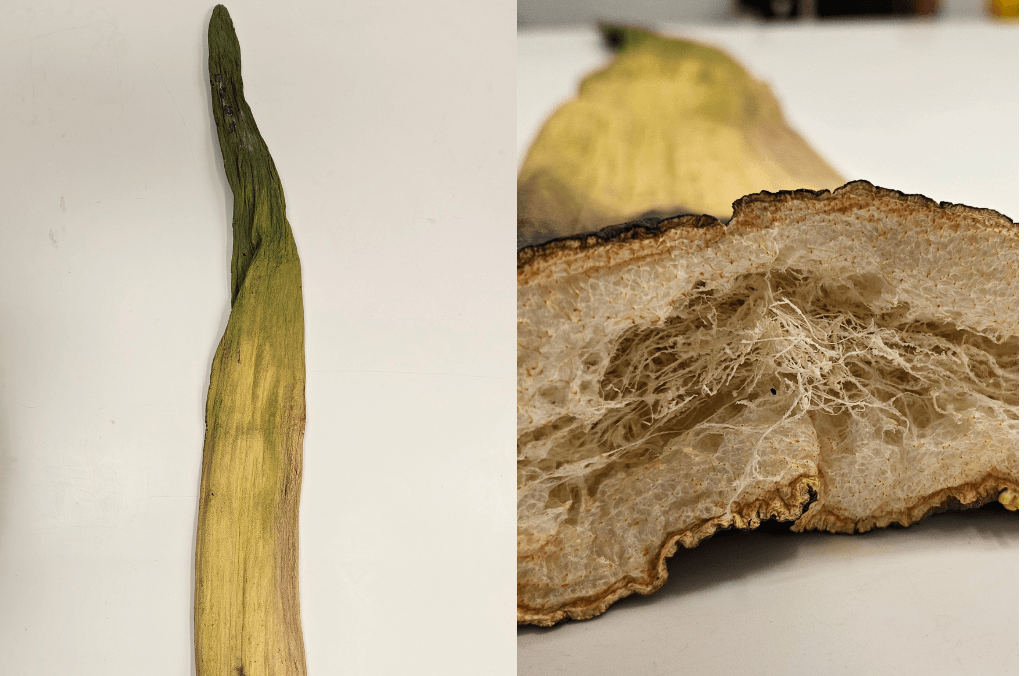
Left: Stinkarella’s spadix; Right: the spongey, fibrous interior 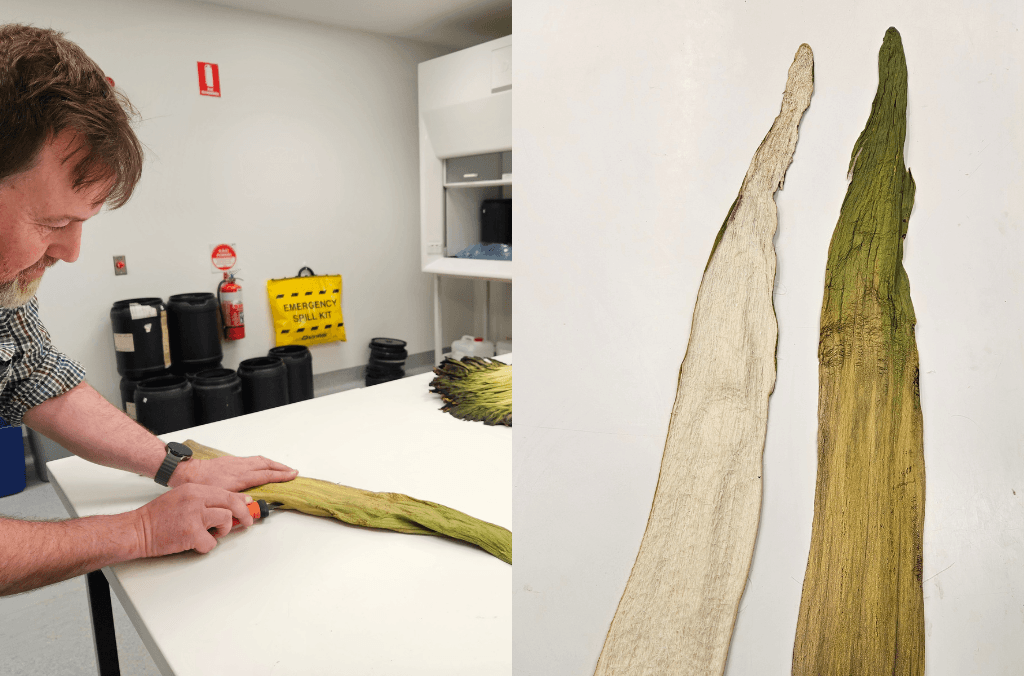
Left: Senior Technical Officer, Andrew Orme cutting the spadix lengthwise; Right: The two halves of the spadix 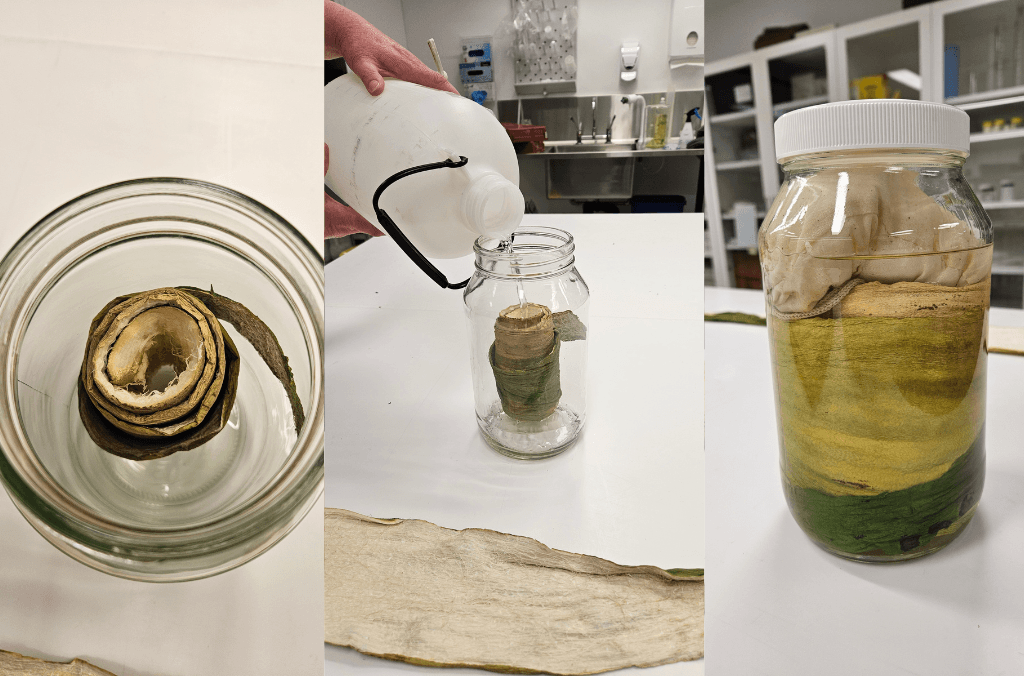
Left: Rolled spadix; Middle: Pouring in the alcohol; Right: Stinkarella’s spadix ready for the spirit collection
Pressing Stinkerella
The team also had some sheaths to press. These are formed in the leaf stage and are shed as the bloom reaches maturity. By the time they arrived at the herbarium they were dry and papery and not flat. They rehydrated them and removed excess water as they had done for the spathe, pressed them in a regular herbarium press and placed them in the drying cabinet.
Using the initial press, lint-free tissue, some fresh newspaper, cardboard and foam - they assembled a new press. One layer had the carefully arranged spathe (still on the cotton paper) and a second layer held the spadix.
They used sheets of plywood to give the press some more rigidity and placed it in the fume hood with weights on top for the initial phase of drying overnight.
The next day the team moved it to the drying room in the Australian PlantBank’s seed store, where it was kept at 15 degrees and 15 percent humidity to continue drying.
After three days they opened the press to check on the drying and pressing progress. The spathe had pressed well. Again, the edges were dry and crispy, but in this flattened state it much less vulnerable to damage. The spongey thick area at the base was still quite wet so they changed the tissues and newspaper for new dry ones, treated a few spots of mould with ethanol and put the press back together to continue drying.
The spadix was still smelly, but drying out and pressing well.
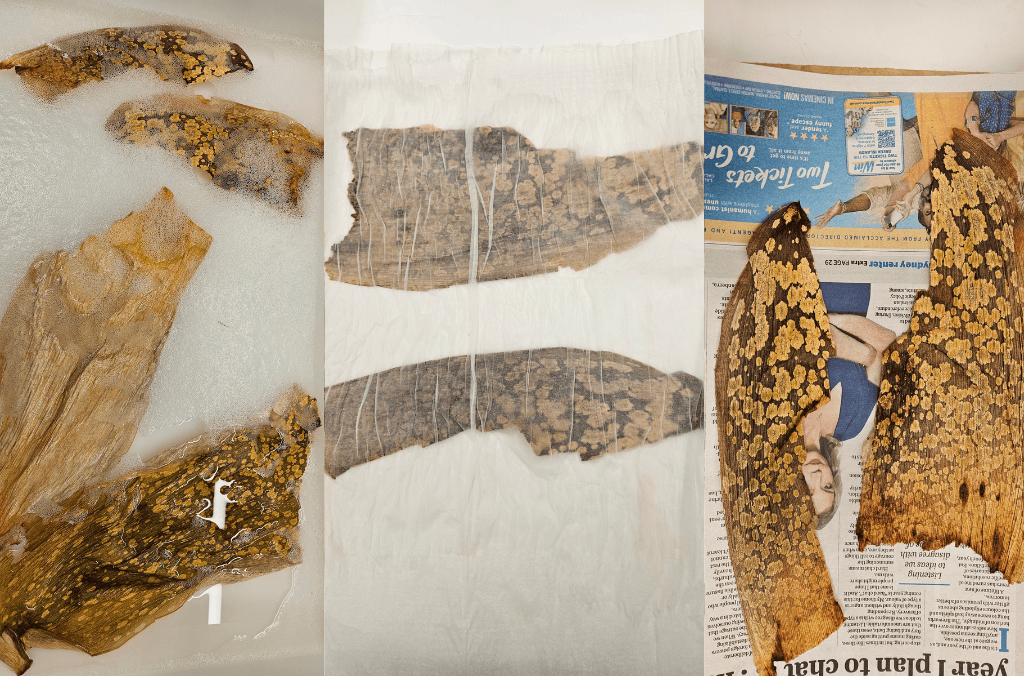
Left: bathing the sheaths; Middle: blotting the sheaths; Right: Sheaths ready for the plant press 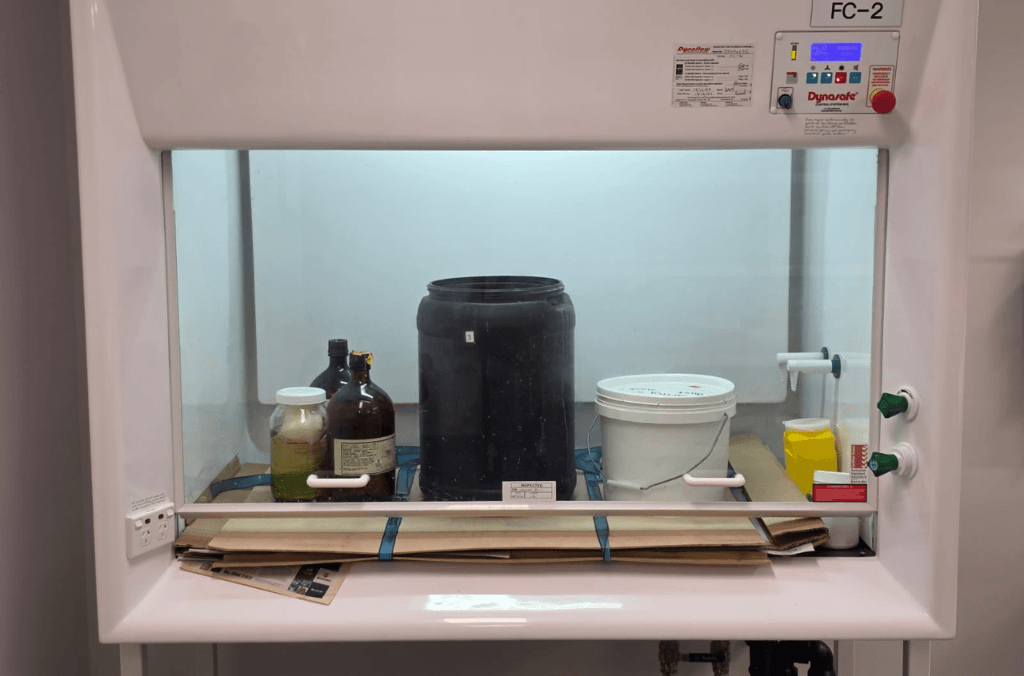
Oversized press with weights in the fume hood in the Herbarium 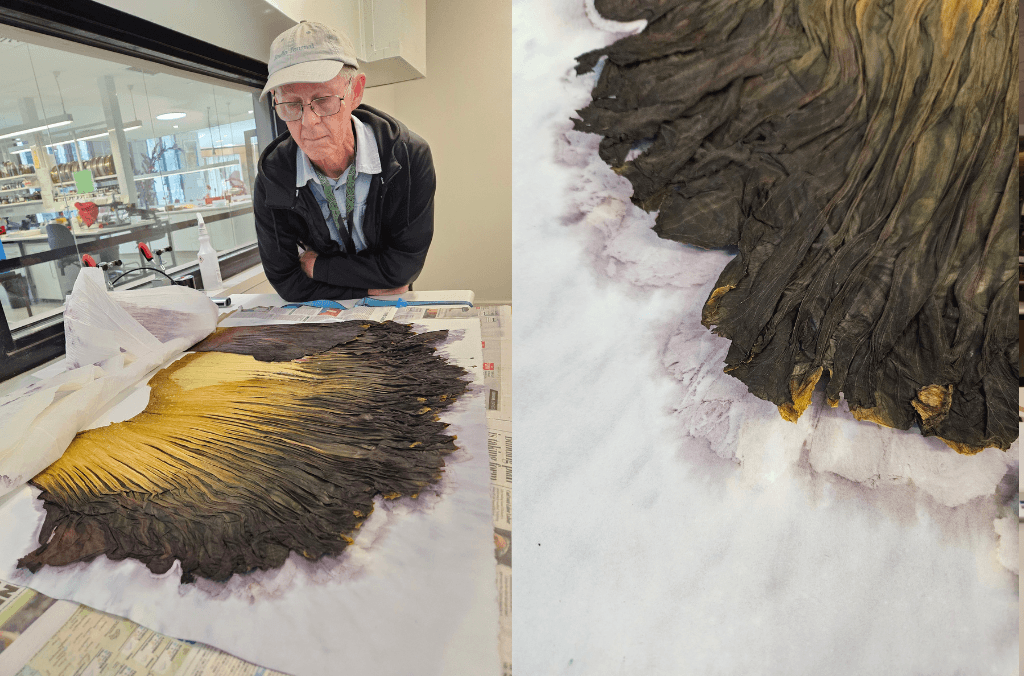
Left: Chief Scientist, Brett Summerell checking out our new herbarium specimen in the making; Right: Dried specimen with flatter, less vulnerable edges; note the stains from the dye on the cotton paper
Preserved for years to come
Two immature fruits and two sections of dead male flowers were also collected and preserved in 70% ethanol to complete the herbarium specimen.
After all this hard work, the final specimen of Stinkerella is now preserved in several forms to ensure its long-term scientific value. The spathe, spadix and sheaths have been mounted on archival paper with accompanying collection information, while the reproductive structures and portions of the spadix have been preserved in alcohol.
Additional samples have been freeze-dried for future DNA analysis. All preserved material is linked in the Garden's collections database and is securely stored in the collection vaults of the National Herbarium of New South Wales, where it will remain available for future research and study.
Thanks to the Horticulture, Collections and Plant Discovery and Evolution teams at Botanic Gardens of Sydney for their combined experience, pragmatism and creativity in adding this remarkable new specimen to the herbarium collection.
Photos were contributed by Daniella Pasqualini, Hannah McPherson, Trevor Wilson and Andrew Orme.
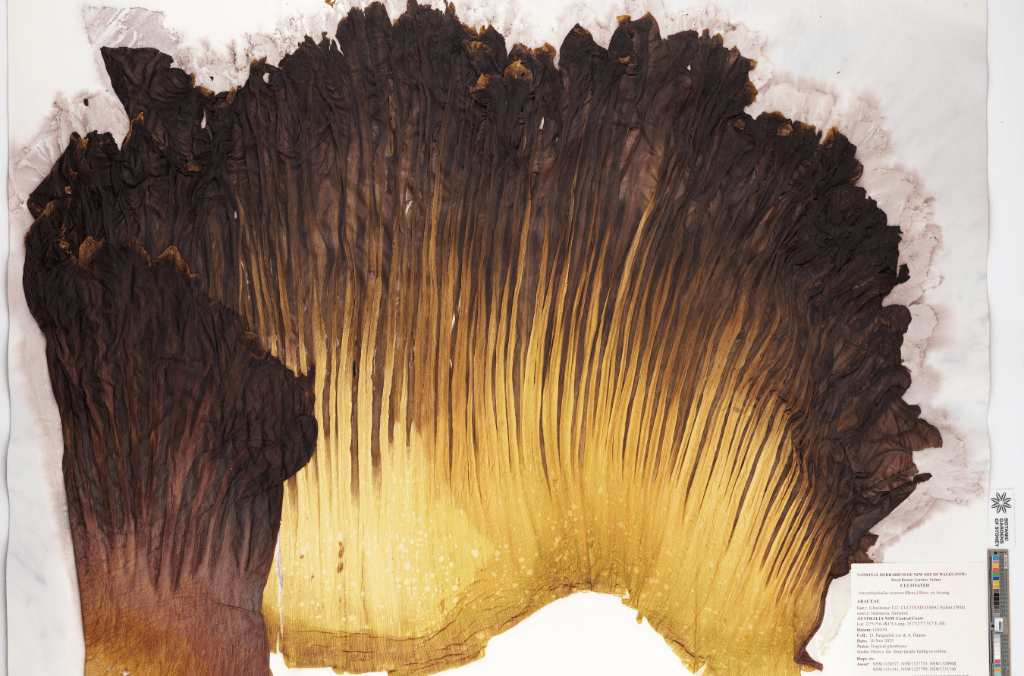
Spathe preserved on archival, cotton paper in the National Herbarium of New South Wales 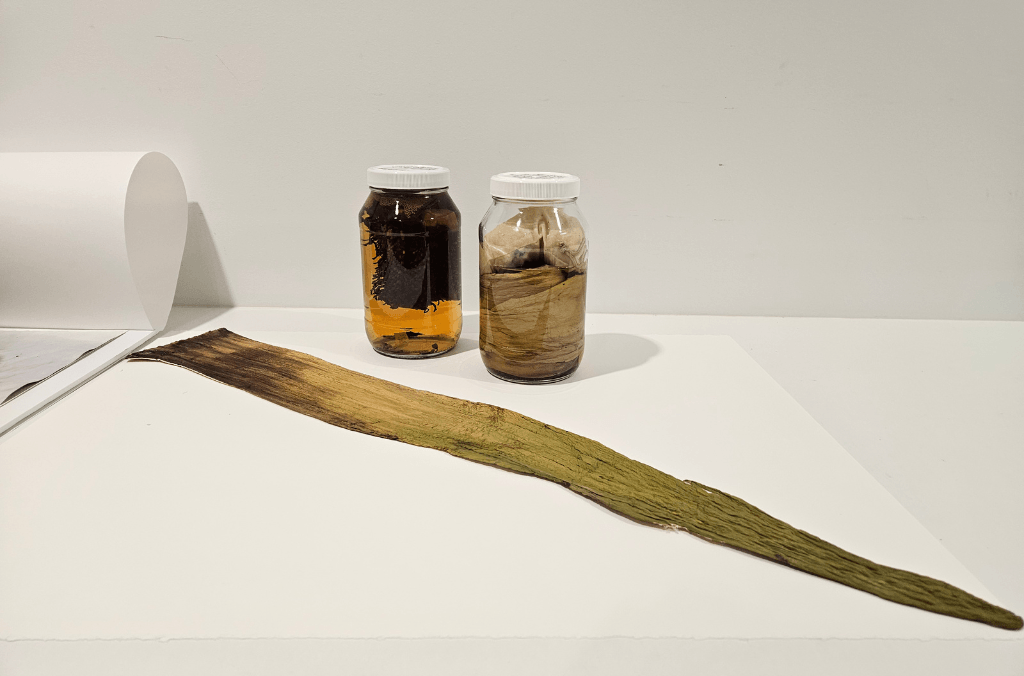
Spadix preserved on archival paper and reproduction corpse flower parts preserved in spirit 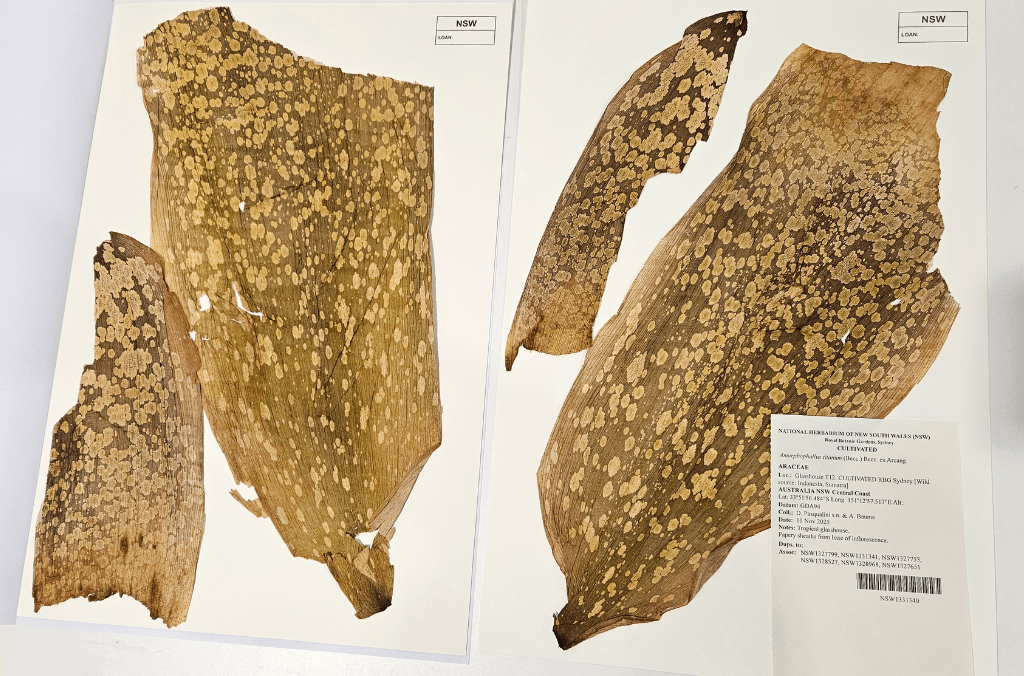
Preserved sheaths
Be a force for nature
Like coming behind the scenes with us? Support the critical conservation work of our scientists or visit the Australian Botanic Garden Mount Annan and join an Australian PlantBank tour to learn more about the critical plant conservation work we do.
Related stories
Peaceful walks or challenging trails, discover all the ways to explore Australia’s largest botanic garden.
Discover the fascinating story behind Sydney's biggest paper daisy display and why these remarkable native flowers captivate visitors every year at Australian Botanic Garden Mount Annan.
In Antarctica’s frozen deserts, scientists are uncovering extraordinary fungi that survive where almost nothing else can, writes Professor Brett Summerell AM, Chief Scientist and Director Science, Education and Conservation.