Where is Putricia the Corpse Flower now?
One year ago, a pungent princess captivated the world when she bloomed at the Royal Botanic Garden Sydney. Our new documentary goes behind the scenes to reveal her rapid rise to fame, her extraordinary life cycle, and the conservation efforts to save this endangered species.
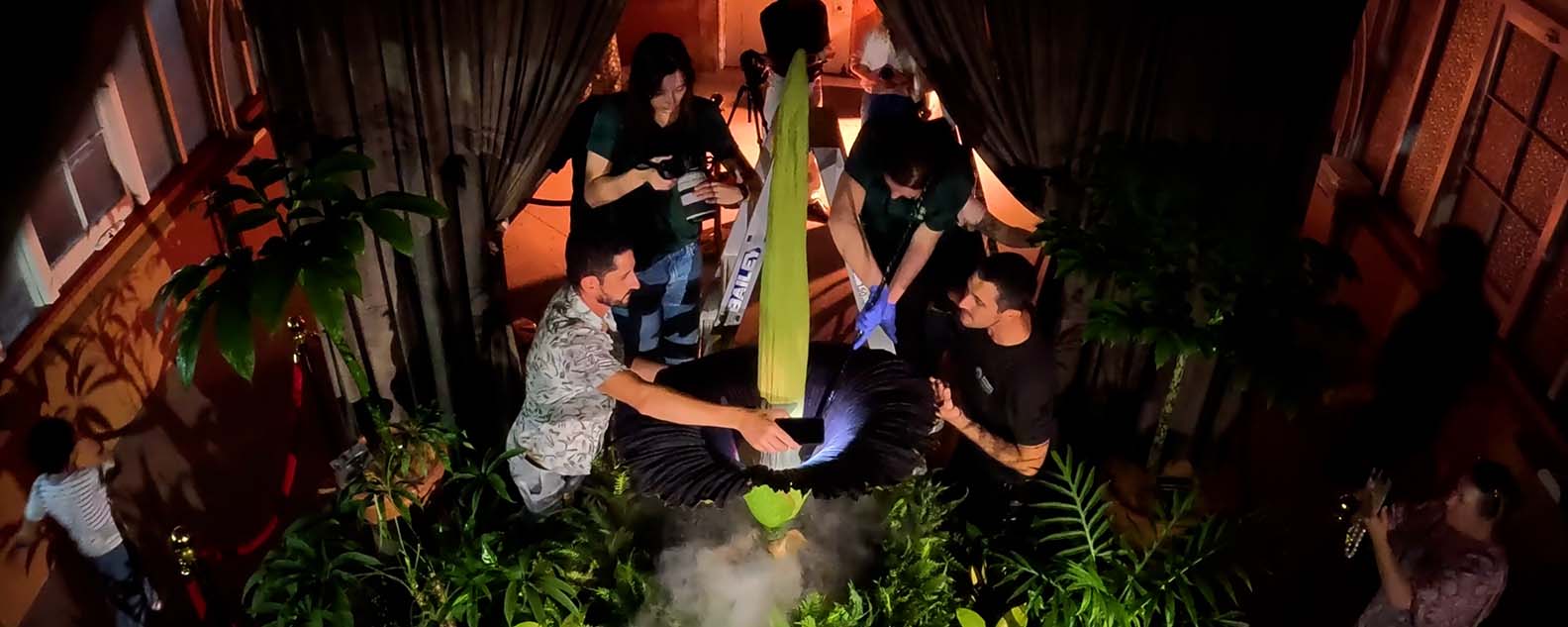
Putricia the Corpse Flower generated a global following worthy of a rock star. This wasn’t just a plant: she was a moment, a movement and a must-see. From online memes to tens of thousands lining up to see her, Putricia inspired a whole new generation to connect with horticulture and science like never before. Later in 2025, two of her clones, Baby Stink and Stinkerella, also bloomed and have helped advance botanical research and the conservation of this endangered Indonesian species.
Putricia the Corpse Flower: The Documentary
In late December 2024, horticulturists working in the Nursery at the Royal Botanic Garden Sydney noticed something peculiar happening with one of the Amorphophallus titanum plants. Daniella Pasqualini, Supervisor Horticultural Development, and her team observed a leaf growing with an inward taper and looking wider, unlike a leaf, suggesting it may be the early stages of a flower.
"A flower comes directly up from its corm, so it gets a little bulge in the centre," says Daniella. "It has a much wider base than the leaf stage, that's what we were looking for, but we couldn't sure until it was a substantial size."
After a few days of speculation and waiting, the ruffled pleats forming near the spadix started to appear, confirming it as a flower. The team quickly sent out emails out to everyone across the Gardens team. What they had discovered would be the first blooming of a corpse flower in 15 years at the Royal Botanic Garden Sydney.
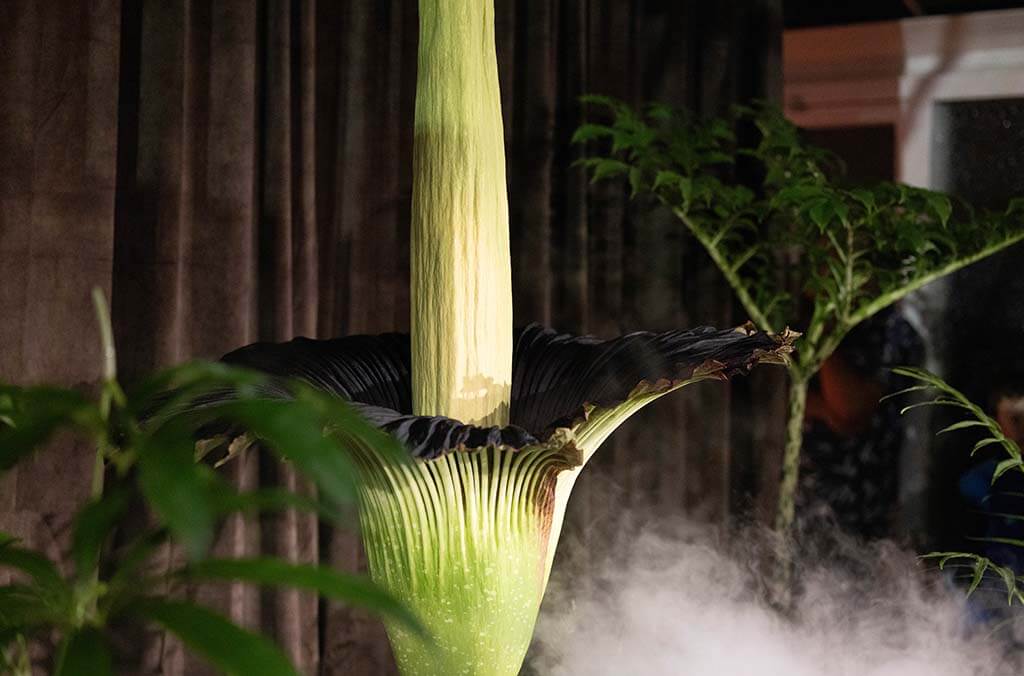
Putricia the Corpse Flower in full bloom at the Royal Botanic Garden Sydney.
What is a corpse flower?
The corpse flower, or Bunga Bangkai as they are known in Western Sumatra Indonesia, where they are endemic, produces the largest unbranched inflorescence of any plant in the world. Their scientific name is Amorphophallus titanum, which translates to "giant misshapen phallus", and their common name is the Titan Arum.
They grow from an underground organ called a corm, which looks a bit like a giant potato and stores energy in the form of carbohydrate. It takes several years for the corm to build up enough energy so that a bloom can be produced. During its non-blooming cycle, the corm produces a single leaf, which can grow up to five metres tall and resembles a small fleshy tree. When the rare event of a flower occurs it only lasts 24-48 hours and its famous for its stinky, dead carcass-like smell, which attracts carrion beetles and flies for pollination.
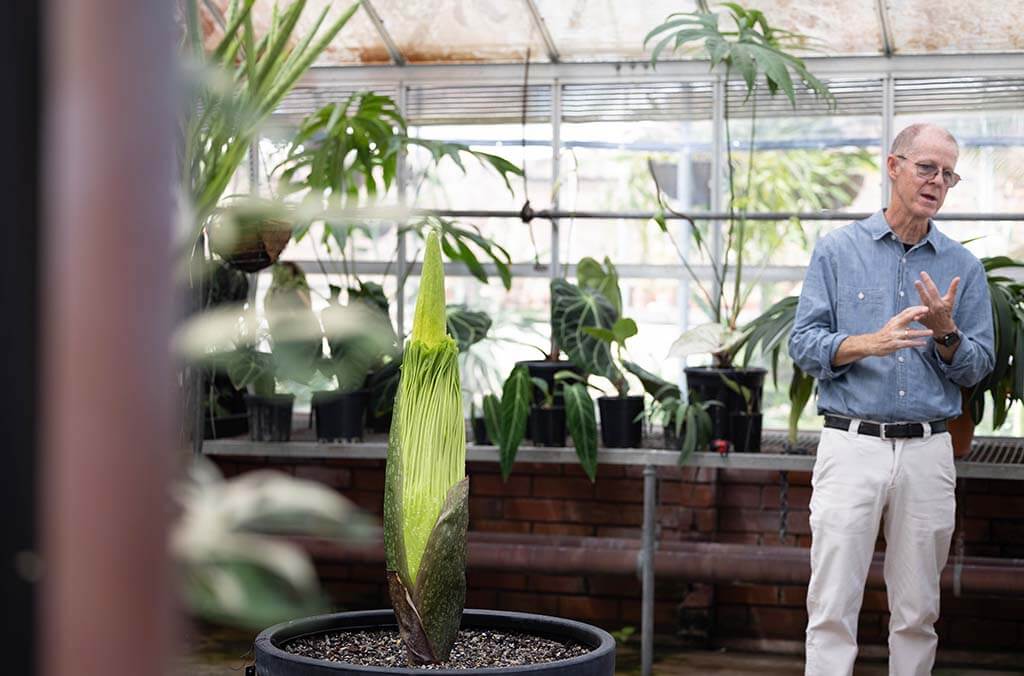
Putricia the Corpse Flower in her early growth stage with Professor Brett Summerell.
Putricia: A star is born
After the young flowers’ discovery, a competition across Botanic Gardens of Sydney staff was held to give the plant a name. Sophie Robinson, Venues Manager, picked the winner with her nomination ‘Putricia’ – a nod to the plant’s ‘Putrescence’, meaning ‘rotting state’, and her Indonesian roots with ‘Putri’ meaning ‘Princess’ in Indonesian.
Over the coming days, horticulturists caring for Putricia watched in awe as she grew up to 10 centimetres every day, tucked away in the humid Aroid Nursery, eventually shooting up to a height of over 170 centimetres by 15 January.
“We were extremely excited to have our own Amorphophallus,” says Daniella. “The next thought we had was about whether we are going to display her for the bloom, it was a huge decision.”
After many conversations across the team, horticulturists and scientists were determined to show Putricia to the public and the online world with a livestream, meaning they would need to move her from the Aroid Nursery all the way down to the Palm House while ensuring she had the right conditions to bloom.
“There was no Googling ‘moving an Amorphophallus titanum into another space’,” says Daniella. "We had to get super creative. The problem with the Amorphophallus is it’s really top heavy. It could topple easily. I was bringing in bags of different materials each day, pool floaties, bedding, you name it. In the end, it came to me one night when I was looking at my huge memory foam wedge pillow, which I realised we could slice up into sections to support her.”
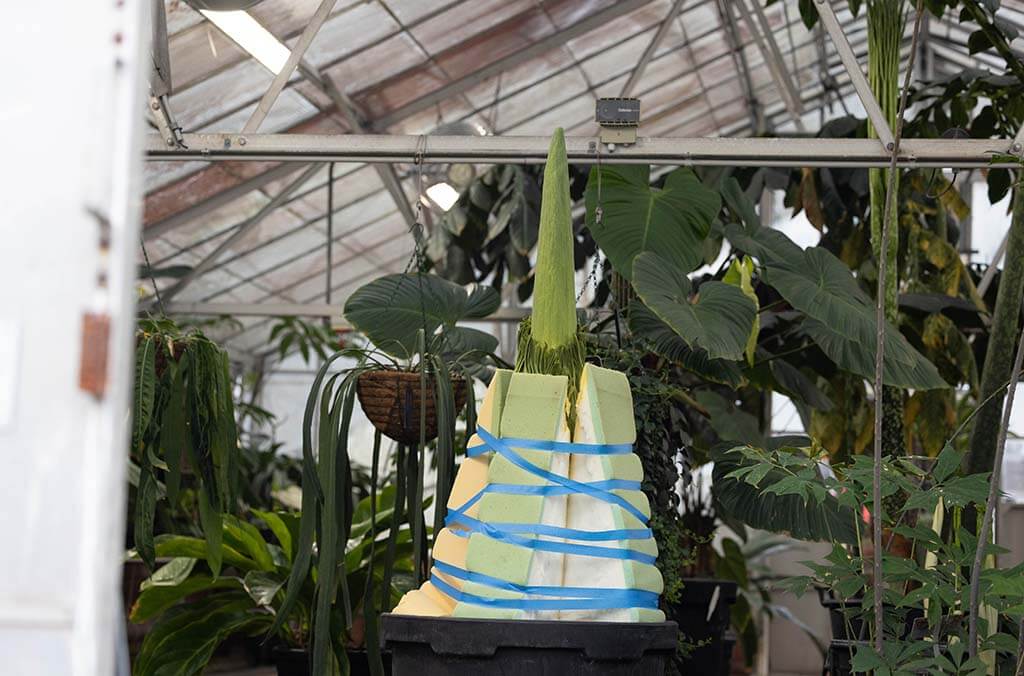
Putricia tucked into a sliced up foam pillow, ready for her move from the Aroid Nursery to the Palm House.
Tucked into carved out pillow slices, Putricia was carefully lifted out of the nursery into a buggy, driven across a bridge and wheeled into the Palm House where she was placed into her throne, designed by Sophie Daniel, Manager Interpretation & Placemaking.
Sophie wanted to use the “perfect marriage” of the Victorian origins of the Palm House and the gothic style of Putricia’s crimson skirt. Mixing inspiration from Queen Victoria’s funeral, vintage sideshow, director David Lynch and the film Little Shop of Horrors, Sophie brought Putricia’s stage to life.
“Victorian gothic is a wonderful genre and we really played into that, celebrating her uncanny and other-wordly splendour. Putricia was presented as a queen, ready to be adored and take her rightful place as a cultural icon,” says Sophie.
Once the livestream from the Palm House launched, Putricia quickly amassed fans from across the world. Devoted watchers knighted her the ‘unproblematic queen’, with acronyms such as WWTF (We Watch the Flower) and BBTB (Blessed Be the Bloom) populating the YouTube livestream chat and memes flooding social media.
Some self-proclaimed ‘Putricians’ made the journey to the Garden to see Putricia in the flesh before she was open. One Superfan, Josh from Lambton High School, visited her every day she was in the Palm House, not wanting to miss a moment.
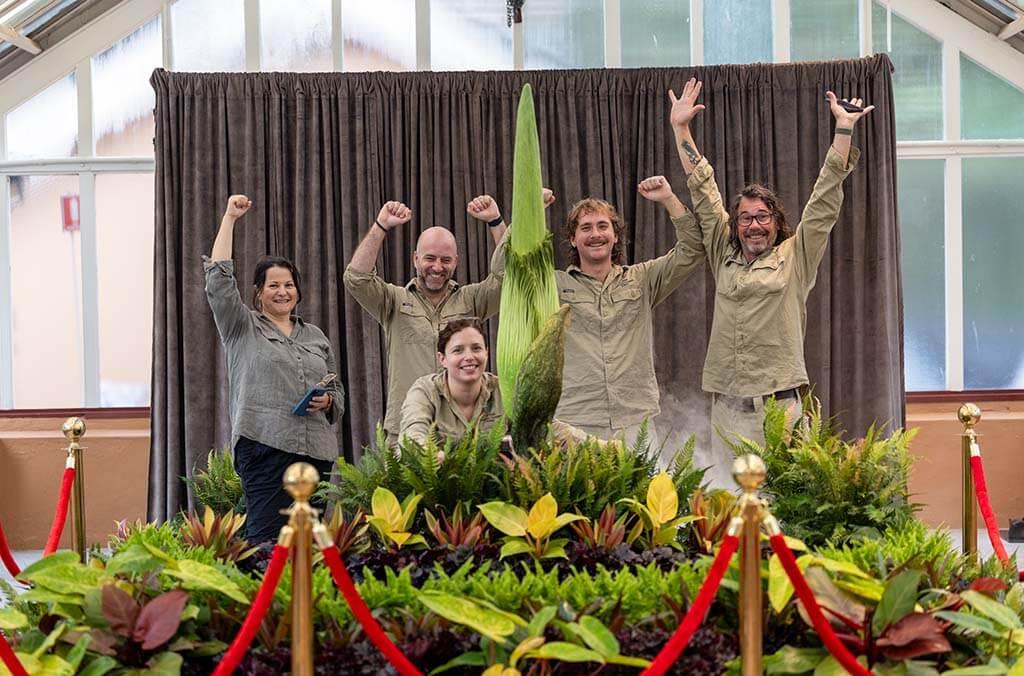
The Nursery team celebrate Putricia's successful move into the Palm House. 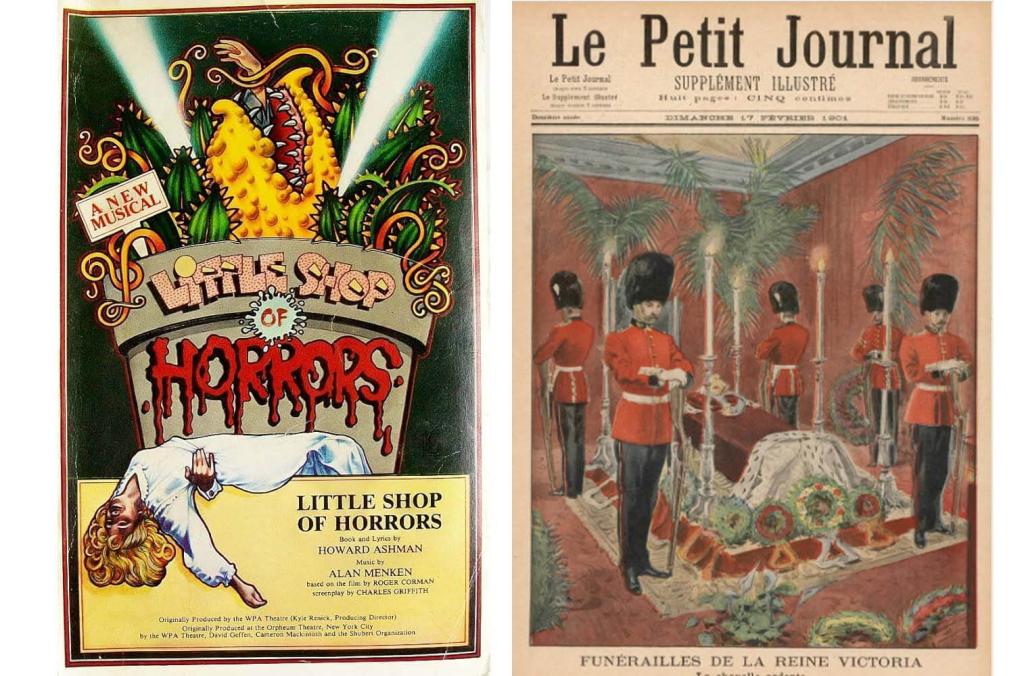
Little Shop of Horrors (left) and Queen Victoria's funeral (right) were used as inspiration for the display. 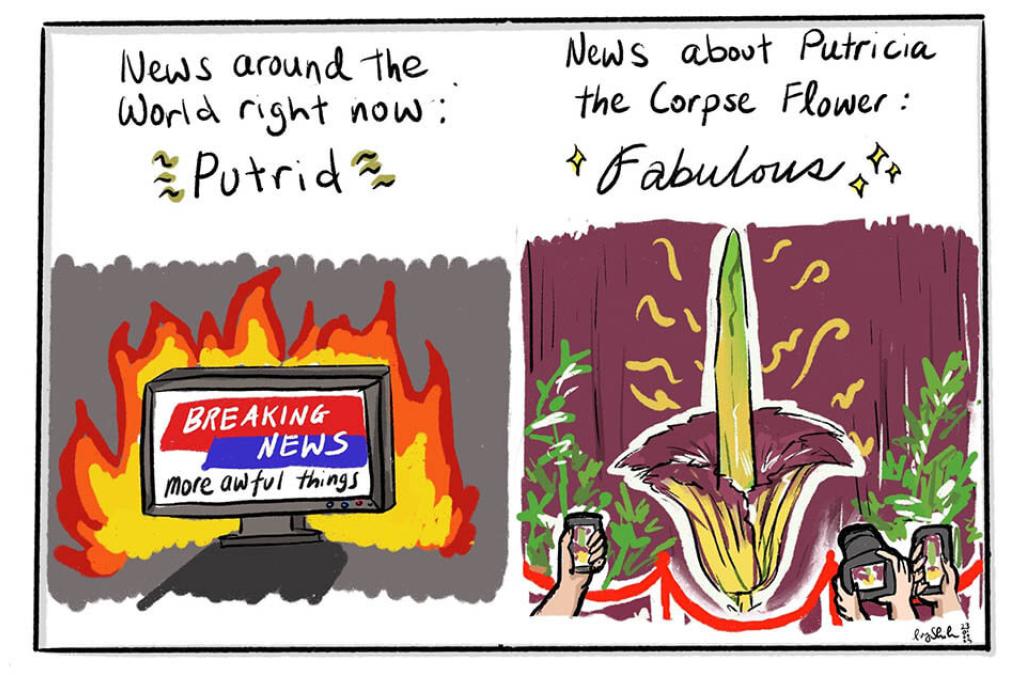
A cartoon of Putricia. 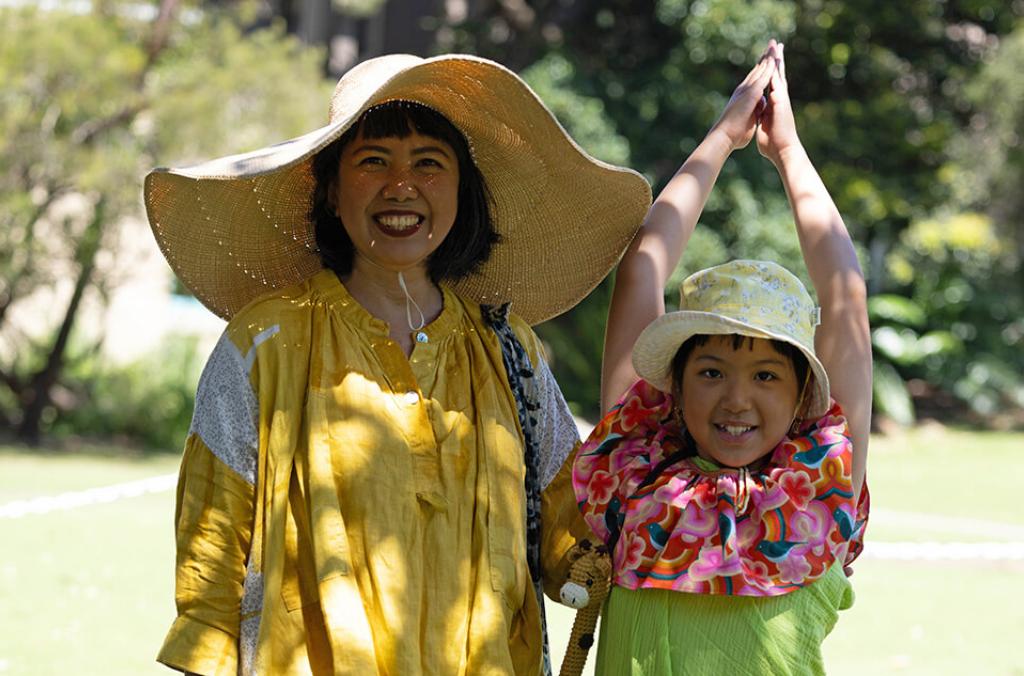
A mother and a daughter dress up as Putricia's spadix and her spathe. 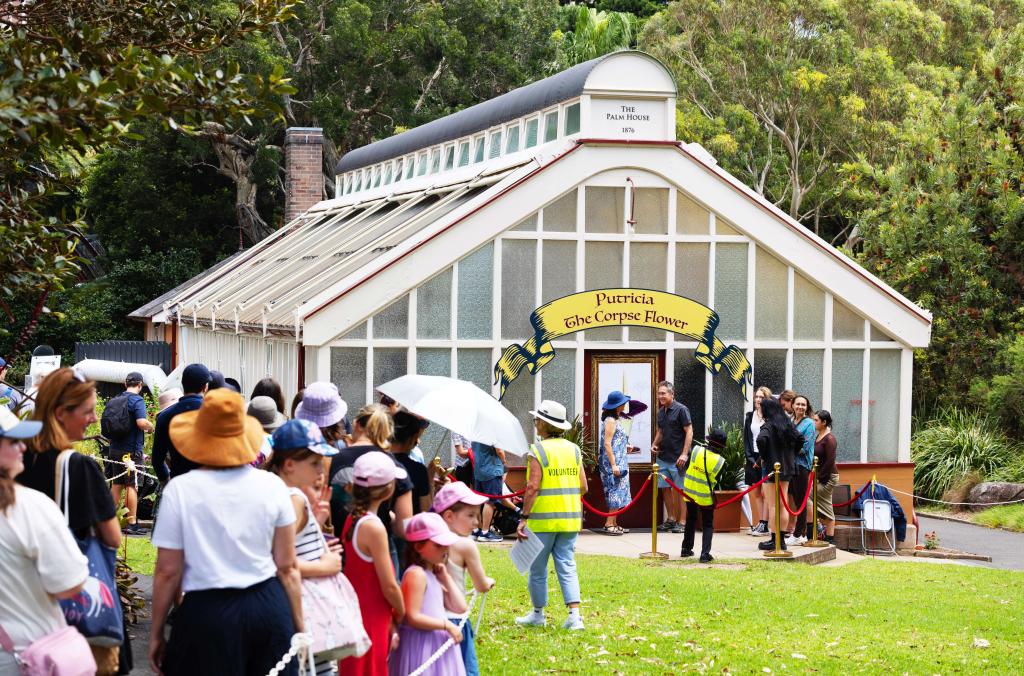
Queues line up to see Putricia near the Palm House.
What happens when a corpse flower blooms?
When a Titan arum is ready to bloom, the inflorescence goes through a process called thermogenesis, heating the tall spadix up to a balmy 37°C. The spathe (skirt like structure around the flower) then opens and reveals the hundreds of tiny sticky velvet tipped flowers.
As these female flowers mature, the fibrous and virtually hollow spadix acts like a giant chimney releasing trails of rotting flesh like odour. This stench tricks pollinators such as carrion beetles and flies into landing on the flowers to lay their eggs. If the insects visit multiple blooms, they can pollinate them by moving pollen from the male flowers of one plant to the female flowers of another.
During the second phase of flowering, the male flowers start to produce pollen. The female flowers are no longer receptive which prevents the plant from self-pollinating. The inflorescence heats up again as the male flowers mature and seep out golden strings of pollen, while the foul smell dissipates.
The spadix slowly starts to droop down and if the flower is pollinated, it will close after just one day of opening. If unpollinated, it can open for up to four days.
After the bloom, the spathe starts to collapse and the spadix begins to wilt slowly shrivelling, leaving behind the the flowers, that if pollinated, will produce many small persimmon coloured berries about the size of a brazil nut.
Once the plant has flowered and fruited, the plant will go dormant until a new single leaf is produced. The sheer volume of energy expended on flowering and fruiting means the plant will take years before its corm has grown enough through its leaf lifecycle to sustain another bloom.
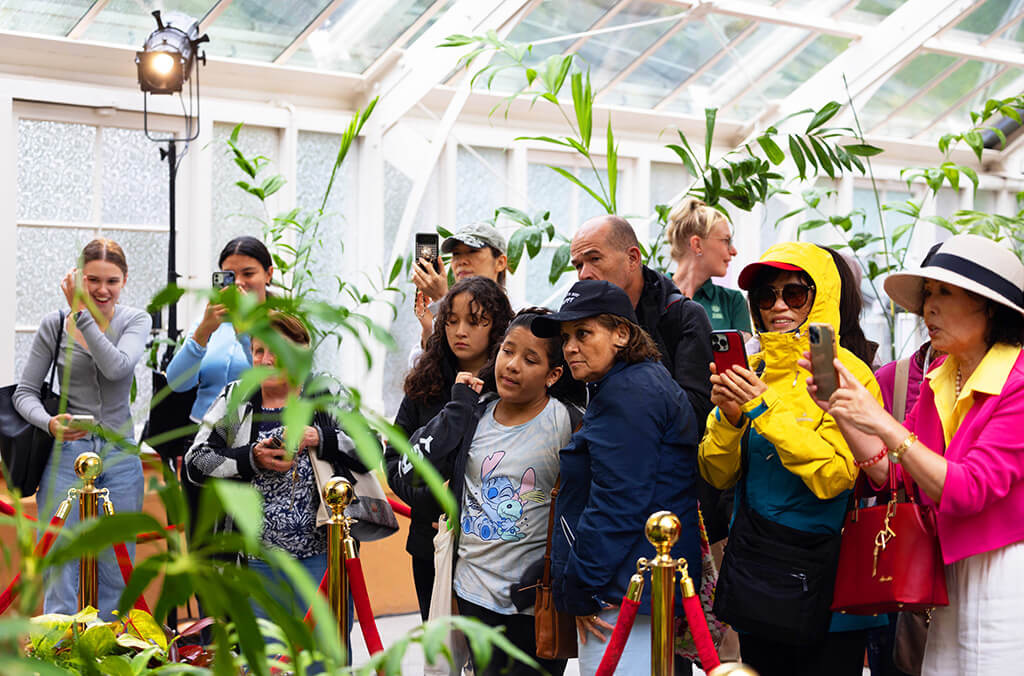
Crowds gather to see Putricia before she blooms.
Studying the smell of death
Bridget Thurn, a PhD Student at University of Technology Sydney, studies the odour of human decomposition and jumped at the chance to conduct odour sample tests on both Putricia and Baby Stink during their blooms.
“I’ve been interested in corpse flowers for a long time,” says Bridget. “Odour is used a lot in forensic science, it’s how detection dogs locate victims in mass disasters, both living and deceased victims. What I do is collect the odour samples in simulated disaster situations and analyse them back in the lab. I wanted to compare the odour of a corpse flower of an actual corpse to see if there’s any truth behind the name. This research would not be possibly without people who donate their bodies to science, we are forever thankful to those donors."
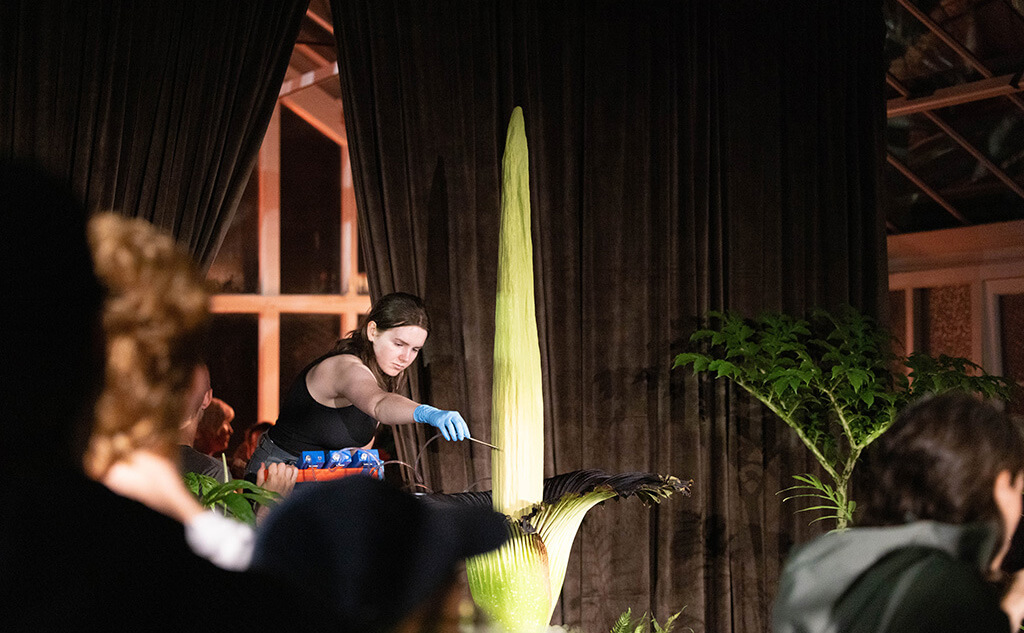
Bridget Thurn analysing Putricia's odours during her bloom.
Putricia’s pollination attempt
With thousands of people walking through the Palm House to see Putricia’s bloom, Horticulturist Alyse Baume and her team attempted to pollinate her amongst all the buzz.
They began by cutting a small hole into Putricia’s spathe and brushed donated frozen pollen on her female flowers in the hopes of producing fruiting seed. They then collected the maturing pollen from the oozing male flowers. The pollen was then transported to the Australian PlantBank at the Australian Botanic Garden Mount Annan and placed into cool storage to ensure viability.
Dr Nathan Emery, Manager Seedbank & Conservation Collections, sampled the first pollen grains collected from Putricia. Testing the pollen for its most viable stage, his research looks for the optimal times for pollen collection and how to optimise storage viability and longevity.
Though pollination was not successful on this occasion, her bloom was a vital piece of the puzzle, bringing essential knowledge to assist with pollinating future blooms at Botanic Gardens of Sydney. The team were able to clean her corm, give her fresh soil and observe a tiny leaf bud ready for sprouting again.
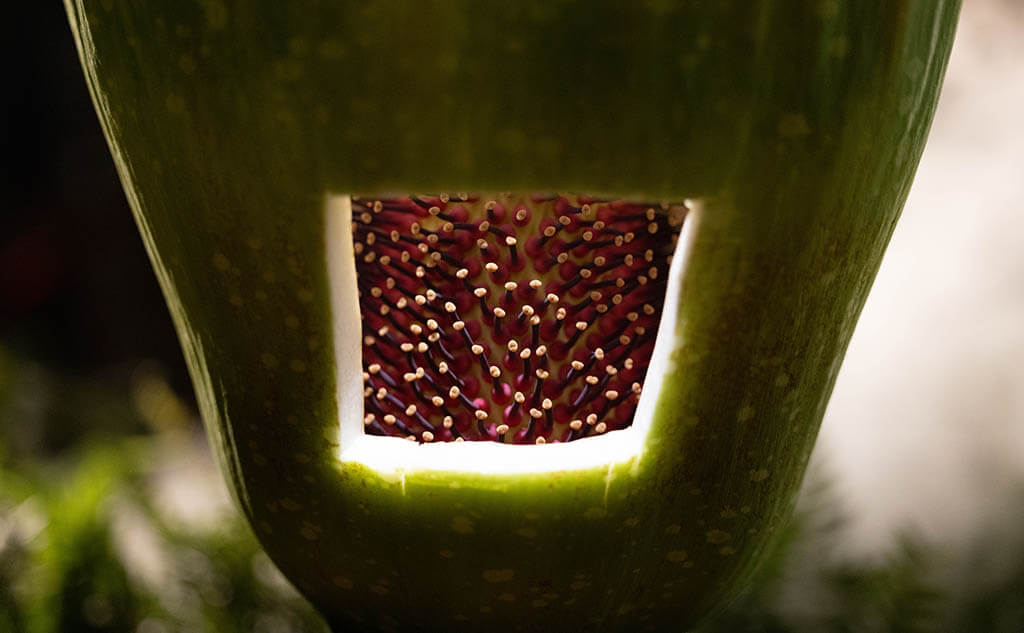
Carving into Putricia's spathe revealed her female flowers for a pollination attempt.
A second bloom: Baby Stink
While Putricia was having her moment in the spotlight, another Titam Arum in the Nursery was growing something special. The second flower that emerged immediately after Putricia was a huge surprise to the Gardens team, and it was affectionately dubbed ‘Baby Stink’. Baby Stink is a clone of Putricia and both these plants are part of a collection of four clones which were donated to the Nursery.
For this bloom, scientists and horticulturists chose to keep Baby Stink out of the limelight, allowing the ideal climate conditions for growth and colllecting materials for scientific research. The flower was maintained in ideal 70% humidity and as a result it bloomed quickly, unleashing a more pungent smell than Putricia.
In calmer conditions than Putricia’s display, John Siemon, Director of Horticulture & Living Collections, and Professor Brett Summerell, Chief Scientist and Director of Education & Conservation, were able to carve off the spadix and maroon spathe. This allowed Dr Nathan Emery to conduct a more in-depth study into the pollen viability.
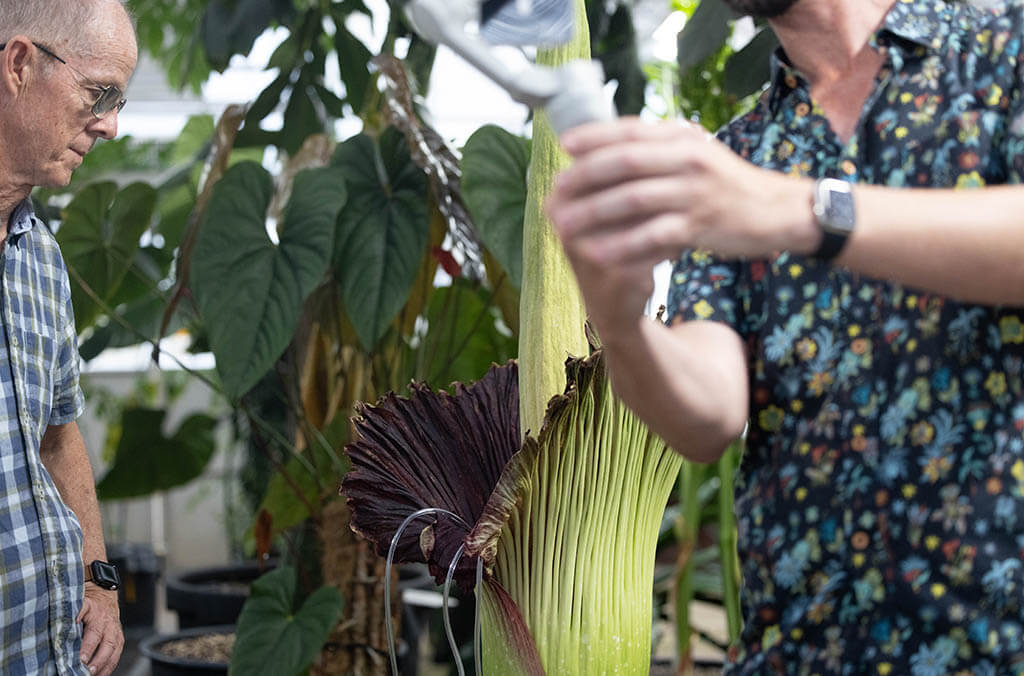
Prof. Brett Summerell and John Siemon streaming the bloom of corpse flower Baby Stink.
A third boom: Stinkerella
At the end of spring in 2025, there was still one more stinky surprise to come from the Nursery. Another plant from Putricia’s genetic line was ready to transform, and in the dead of night on Sunday 9 November, ‘Stinkerella’ became the third bloom the Gardens had in a year, marking an important milestone in our conservation journey.
As Stinkerella unveiled her stench, Daniella Pasqualini and her team collected her precious pollen to help strengthen the genetic diversity of our corpse flowers in the Living Collection. The team also made another pollination attempt with pollen donated from OddSpots Nursery in Gympie, Queensland.
Stinkerella also made history with another vital contribution to our science. After her spadix and spathe were removed, they were transported carefully to the National Herbarium of New South Wales. The team delicately preserved the flower parts, making her the first Amorphophallus titanum specimen join the herbarium collection. The preservation of the corpse flower is an invaluable contribution for scientists studying the conservation of the endangered species.
Horticulturists Brynn Gordon, Daniella Pasqualini and Alyse Baume with corpse flower Stinkerella.
The future of the corpse flower
“Following Putricia, I think we became more and more conscious of the limitation of our collection in terms of its genetics, and that we would always need to approach other donors for pollen,” says Daniella.
Late last year, Daniella and her team sought to increase the genetic diversity of the collection. Through a collaboration with Belgium Botanic Gardens, they were able to take delivery of ten special Titan Arum seeds from a record-breaking specimen in Belgium that measures over three meters tall.
“We have a few seeds in a nice, beautiful warm sphagnum moss growing. A few of them have shot tiny little baby leaves and they have tiny little baby roots.”
Though the Belgium specimens will take many years to produce their first flowers, the new genetic line will strengthen the diversity of the Living Collection and our understanding of the species.
Now Putricia's leaf stands over five metres tall in our Aroid Nursery and will continue her leaf cycle until one day she's ready to flower again.
All three blooms in 2025 deepened the Gardens’ understanding of these giant, gloriously grotesque marvels of the plant world. With data collected from all three pollination attempts and a new public adoration for these plants, Botanic Gardens of Sydney aims to further conservation efforts for this West Sumatran wonder.
“Seeing the city and indeed the world embrace Putricia was so uplifting for our organisation and our conservation goals,” says Chief Executive Simon Duffy AM. “My hope is that this momentum strengthens the Gardens’ ongoing efforts to conserve not only this remarkable species but also a future rich in wildlife where plants are at the heart of a thriving world.”
Protect plants for the future
Do you want to help protect endangered species like the Amorphophallus titanum? Donate now to support our vital conservation work.
Related stories

Discover the fascinating story behind Sydney's biggest paper daisy display and why these remarkable native flowers captivate visitors every year at Australian Botanic Garden Mount Annan.

In Antarctica’s frozen deserts, scientists are uncovering extraordinary fungi that survive where almost nothing else can, writes Professor Brett Summerell AM, Chief Scientist and Director Science, Education and Conservation.
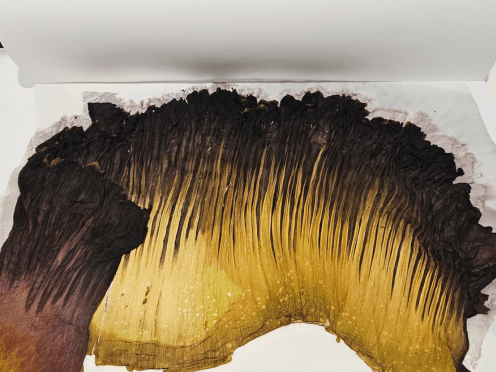
Come behind the scenes on a botanical journey to preserve the first ever corpse flower in the National Herbarium of New South Wales.